Summary: Researchers reveal a deeply unified mammalian brain blueprint for olfaction. By tracking free-roaming mice with high-velocity robotic cameras and recording directly from the olfactory bulbs of conscious human volunteers, the researchers proved that mice possess the capacity for single, volitional “smell checks” that mimic human behavior. Conversely, humans process odor data inside a single sniff using rapid neural rhythms that mirror those of rodents.
Key Facts
- The Volitional Rodent Sniff: In the first study, led by the Shepherd lab, scientists engineered a robotic multi-camera setup to track free-foraging mice. They observed that when a mouse handles a crumb, it will execute a single, highly deliberate, precisely timed sniff coordinated with its head and hands—a proactive “smell check” rather than a passive reflex.
- Motor Cortex, Not Odor Driven: When researchers chemically blocked the mice’s sense of smell, the food-sniffing behavior continued completely unabated. However, when they silenced the motor cortex (the brain region responsible for conscious, intentional action), the behavior completely stopped, proving the single sniff is entirely volitional.
- The Slow Human Inhale Solved: Humans sniff roughly ten times slower than rodents, creating a long-standing neurobiological paradox: how do humans identify complex smells just as rapidly as mice despite their sluggish breathing rate? The second study, out of the Zelano lab, isolated the exact neural clockwork solving this problem.
- Theta Oscillations Engaged: By placing high-precision recording arrays directly inside the human olfactory bulb, researchers discovered that a single, deliberate human inhalation instantly triggers theta oscillations (2–8 Hz). This is the exact same frequency range at which rodents physically sniff.
- The Independent Internal Tempo: While a rodent’s theta rhythm is mechanically fused to its physical breathing cycles, the human brain generates this rhythm independently. A single human sniff acts as a master key, launching an internal theta wave that packages fast, high-frequency bursts of odor processing into ultra-rapid windows identical to a rodent’s tempo.
- Clinical Diagnostic Horizons: Behavioral changes in sensory sampling and olfaction fragmentation are early clinical indicators for neurodevelopmental and neurodegenerative disorders, including Autism, Alzheimer’s, and Parkinson’s disease. Mapping this core mammalian wiring offers an explicitly calibrated baseline to catch early pathological failures before widespread decay sets in.
Source: Northwestern University
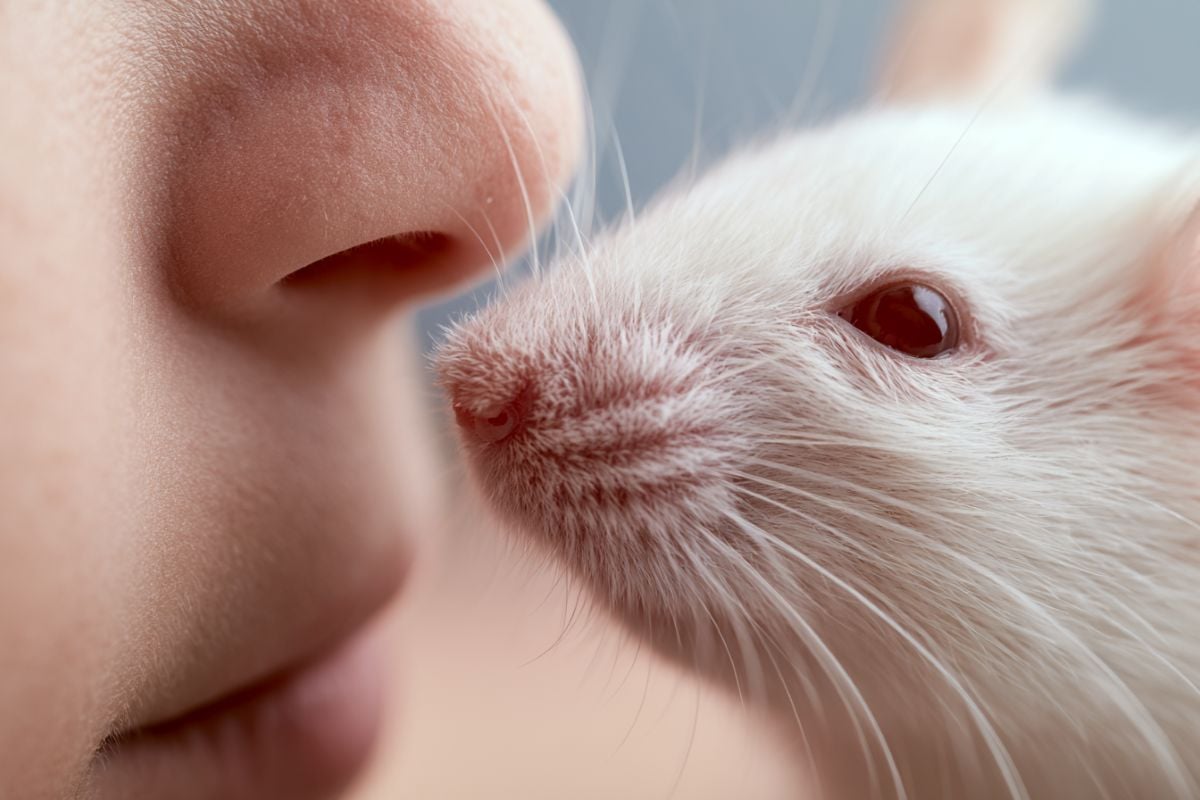
Picture a mouse taking rapid, staccato sniffs of a crumb it’s found while foraging for food. Now compare that with a human, leaning in for a single, deep inhale to gauge if a cantaloupe is ripe.
New research from Northwestern University has found, like humans, mice also can take a single sniff to deliberately probe their environment — something scientists previously did not know.

Two new complementary Northwestern University studies, which will be published together July 3 in Science Advances, studied olfaction from opposite ends and found rodents and humans rely on the same underlying neurophysiology — the brain’s motor and rhythmic building blocks — to process smells.
Although a mouse’s single sniff is much shorter than a human’s, the underlying tempo of smell processing is the same, according to the findings. The results suggest these sensory systems are fundamentally similar and have been preserved through evolution.
Taken together, the findings from the two labs suggest something important: Mammals all rely on a similar underlying system for smell, with each species putting its own twist on the same basic design. The work answers a fundamental question: How do mice and humans sample our environment so we understand it and predict the next thing we want to do?
“The true similarity is this single sniff, but it’s not just a sniff,” said corresponding author John M. Barrett, research assistant professor of neuroscience at Northwestern University Feinberg School of Medicine. “Mice even move their hands while sniffing, which shows it’s volitional — they’re doing it on purpose.”
What are the implications for humans?
Behavioral changes in sniffing are linked to conditions like autism and Alzheimer’s and Parkinson’s diseases, so understanding the olfaction system’s basic wiring could help with earlier detection or better treatments, the study authors said.
“Knowing we have this evolutionarily conserved set of mechanisms helps us understand how mammalian brains work, which could ultimately help us understand how they fail in pathology,” said first author Andrew Sheriff. “It helps us know how the brain works so we know how to fix it when it doesn’t work.”
A tale of two papers
One study found mice inspect their food using single sniffs that look remarkably human-like. The other found humans organize odor information at a rapid rate within a single sniff, in a form of olfactory brain processing that looks remarkably rodent-like. Together, these separate but complementary studies suggest there are shared, fundamental biological rules behind how these two mammals’ senses of smell work, and that these have been preserved through evolution.
First study: mice can sniff like humans
The first paper began with a simple observation: When mice handle food, they’ll occasionally bring it briefly to their noses before continuing to eat.
The study was conducted in the lab of Gordon M. G. Shepherd in the department of neuroscience at Northwestern University Feinberg School of Medicine, along with colleagues locally and at the University of Pennsylvania and University of Florida College of Medicine.
The team built a robotic multi-camera recording system to follow mice around as they forage and eat. Led by Mang Gao and Barrett from the Shepherd lab, the scientists tracked at high resolution the mice’s hand and head movements while simultaneously tracking their breathing.
The mice timed a single sniff to the exact moment the food reached their nose, precisely coordinating their hands, head and breathing. Unlike the steady sniffing they use when searching for food, this behavior is quick and deliberate, much like when a human lifts food to their nose for one careful smell before taking a bite.
The mice sniffed more vigorously when handling unappetizing food, the study found, but it was not only the presence of odor that drove the behavior. When the scientists interfered with the mice’s sense of smell, they continued performing food sniffs as normal. What ultimately stopped the behavior was silencing the motor cortex — the region of the brain associated with conscious, intentional movement.
“This means when mice sniff food, they’re not doing it as a reflexive response to an odor, but rather as a proactive act of deliberate sensory sampling,” said Gao, a postdoctoral scholar in the Shepherd lab.
“It turns out the mice choose to perform these quick ‘smell checks,’ which is characteristic of a lot of human olfactory behavior, rather than being passively triggered to sniff.”
This is the first study to document this intentional, non-reflexive sniffing behavior among rodents in a real-world setting.
Second study: humans can process odors like mice
The second study, from the lab of Christina Zelano in the department of neurology at Feinberg, in collaboration with Dr. Bruce Tan in the department of otolaryngology at Feinberg, sought to answer how humans can achieve the same perceptual precision as rodents with a single, slow sniff.
“We wanted to understand how we can identify odors as fast as rodents do even though we sniff over 10 times slower,” said Sheriff, a postdoctoral scholar in Zelano’s lab.
“By recording directly from the human olfactory bulb using a novel technique, we were able to find rhythms of odor processing that closely resemble those of rodents, suggesting conserved time windows for olfaction across species.”
The team used a minimally invasive, high-precision method developed in the Zelano lab to record sniffing in the brains of healthy human volunteers. When participants breathed in a single intentional inhalation, it elicited low frequency brain waves called theta oscillations (2–8 Hz) in the human olfactory bulb, at precisely the same frequencies at which rodents sniff.
This slow brain rhythm helps organize faster bursts of activity that happen when the brain is actually processing a smell, the study found, meaning the human brain can generate the theta rhythm from a single sniff and use it the same way rodents use their sniff cycle.
“The implications of our findings are significant,” said co-author Qiaohan Yang, a graduate student in Northwestern University Interdepartmental Neuroscience.
“In rodents, sniffing and theta are so tightly fused that the two are nearly indistinguishable. In humans, the slower sniff rate pulls them apart, revealing the theta oscillation as a distinct, independently generated rhythm that a single deliberate inhalation is sufficient to engage.”
Key Questions Answered:
A: This was the major discovery of the first study out of the Shepherd lab. When mice are hunting around, they use automatic, rhythmic breathing to map space. But the moment they pick up a piece of food, they execute a highly coordinated movement, bringing the crumb to their nose for one deliberate, clean intake of air. The researchers proved this isn’t a passive reflex triggered by the smell itself; it is a conscious, proactive behavior controlled entirely by the brain’s motor cortex. It is the exact evolutionary equivalent of a human lifting a fork to their face to check a bite before eating it.
A: This paradox was cracked by the Zelano lab’s direct recordings of the human brain. In mice, their physical sniffing speed matches their brain’s processing speed perfectly. Because humans breathe much slower, our brains have evolved to decouple the physical act of inhaling from the internal processing speed. The moment you take one single, intentional sniff, your olfactory bulb instantly generates a hidden, fast-moving brain wave called a theta oscillation (2–8 Hz). This internal rhythm acts like a high-speed engine, breaking down and organizing odor information within milliseconds, using the exact same time windows that a mouse uses.
A: The sense of smell is often one of the very first systems to break down in neurodegenerative disorders like Alzheimer’s and Parkinson’s, as well as neurodevelopmental conditions like Autism. Patients frequently display subtle, unnoticeable changes in how they physically sample and process odors years before major cognitive or motor symptoms appear. By proving that humans and mice share the exact same underlying motor and rhythmic brain circuitry for smell, scientists now have a highly accurate, evolutionarily conserved model. This allows them to design sensitive diagnostic tools to catch early brain system failures and test targeted therapies to repair them.
Editorial Notes:
- This article was edited by a Neuroscience News editor.
- Journal paper reviewed in full.
- Additional context added by our staff.
About this olfaction and neuroscience research news
Author: Kristin Samuelson
Source: Northwestern University
Contact: Kristin Samuelson – Northwestern University
Image: The image is credited to Neuroscience News
Original Research: The findings will be presented in Science Advances