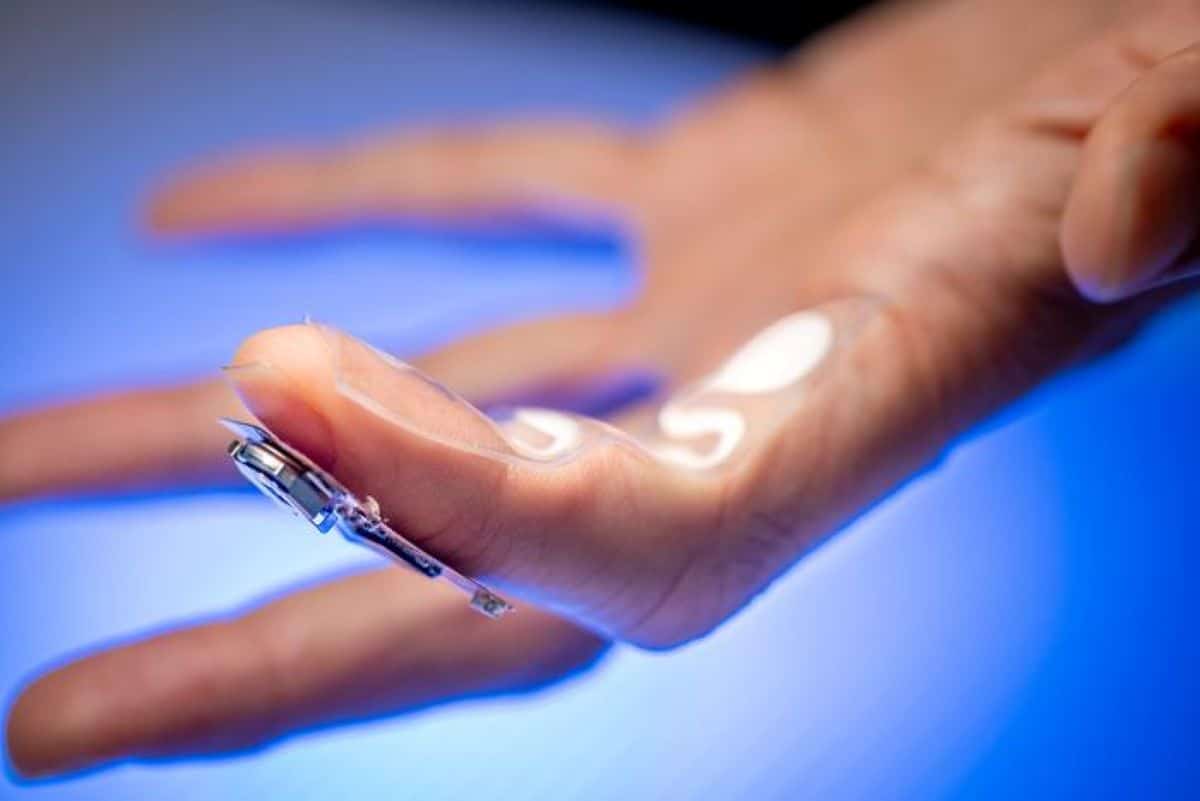
Summary: Engineers and neuroscientists have developed a soft, battery-free fingertip patch that continuously measures levodopa levels in human sweat in real time.
The non-invasive wearable device leverages an engineered absorbent salt gel to extract sweat from the dense sweat glands of the fingertip. When levodopa in sweat interacts with enzymes embedded within the patch, it triggers a biofuel reaction that simultaneously generates its own electrical power and yields a precise voltage readout corresponding to systemic drug concentrations.
Clinical trials demonstrated that the device matches the diagnostic accuracy of standard laboratory blood tests while uncovering that Parkinson’s patients metabolize and clear levodopa significantly faster than healthy control subjects.
Key Facts
- Battery-Free Operation: The fingertip patch utilizes a enzymatic biofuel cell mechanism; the chemical reaction between sweat levodopa and embedded enzymes generates the electrical voltage required to power the sensor and measure drug concentration.
- Fingertip Sweat Sponge Mechanics: An engineered absorbent gel loaded with concentrated salts and benign solvents actively draws sweat from high-density fingertip pores via osmotic pressure without requiring physical exertion or thermal stimulation.
- Clinical Accuracy Matching Blood Tests: Human trials confirmed that the patch’s real-time electrochemical measurements match the quantitative accuracy of traditional high-performance liquid chromatography blood tests while eliminating lab processing delays.
- Accelerated Drug Clearance Insight: The study revealed that individuals with Parkinson’s disease clear levodopa from their systems significantly faster than healthy individuals, providing a biological explanation for sudden motor fluctuations and off-state periods.
- Foundation for Closed-Loop Systems: By providing continuous, objective pharmacodynamic data, the device paves the way for closed-loop therapeutic systems that automatically trigger automated pump drug delivery when levodopa levels drop below the therapeutic window.
Source: UCSD
Engineers and neuroscientists at the University of California San Diego have developed a soft, wearable fingertip patch that continuously tracks a patient’s Parkinson’s disease medication levels through their sweat. The device operates using chemicals in the patient’s sweat — no batteries required. Its measurements were comparable to those obtained by standard laboratory blood tests.
The technology, published in Proceedings of the National Academy of Sciences, could enable doctors to precisely customize daily medication schedules for patients at home.

The patch monitors levodopa, the gold-standard drug for managing the loss of motor control caused by Parkinson’s disease. Prescribing the right dose is challenging: reducing levodopa leaves patients unable to move, while too much triggers severe, uncontrollable jerking movements. Initially, the drug’s effects can last several hours.
But as the disease progresses, the therapeutic window narrows down to two hours. Currently, clinicians must rely on subjective patient diaries to adjust treatment. Unfortunately, these methods fail to catch dangerous dosing gaps.
The new wearable device offers a way to continuously track real-time concentrations of levodopa in the body.
The research was led by study co-first author Tamoghna Saha, a postdoctoral researcher in the lab of Joseph Wang, professor in the Aiiso Yufeng Li Family Department of Chemical and Nano Engineering at the UC San Diego Jacobs School of Engineering. The engineering team developed the technology in joint collaboration with the lab of Irene Litvan, professor in the Department of Neurosciences at UC San Diego School of Medicine.
The project is part of a longstanding collaboration between the Wang and Litvan teams to develop wearable levodopa monitors that can improve personalized care for people living with Parkinson’s disease.
The patch is worn on the fingertip, which is packed with a high density of sweat glands. The patch is equipped with a specially engineered absorbent gel that acts like a sweat sponge. The gel contains a highly concentrated mixture of salts and benign solvents — and that draws sweat out of the pores, since water naturally flows toward areas with higher salt concentrations.
When levodopa in the patient’s sweat comes into contact with enzymes embedded in the patch, it triggers a chemical reaction, which in turn generates a small, measurable voltage. This chemical reaction is what powers the patch. The amount of voltage generated also serves as an indicator of the patient’s levodopa level: lower voltage signals low levels, while higher voltage signals high levels.
In clinical tests involving both healthy volunteers and patients with Parkinson’s, the patch tracked levodopa levels as accurately as standard laboratory blood tests, which take days to return results. The data revealed that individuals with Parkinson’s clear levodopa from their systems significantly faster than healthy individuals. This result explains why a patient’s Parkinson’s symptoms can deteriorate so suddenly, the researchers noted.
This technology lays the groundwork for a closed-loop system, where a levodopa monitoring patch could communicate with a pump to automatically deliver the precise doses of the drug right when the body needs it.
Full study: “A Wearable Patch for Continuous Levodopa Monitoring in Sweat: Towards Exertion and Power-Free Pharmacodynamic Assessment in Parkinson’s.” Co-first authors of the study are Tamoghna Saha, Muhammad Inam Khan and Katherine Longardner, UC San Diego.
Funding: This research was supported by the UC San Diego Parkinson and Other Movement Disorders Center, the Center for Wearable Sensors, the National Institutes of Health (1R01NS141451-01) and Emory HPLC Bioanalytical Core (RRID:SCR_023531).
Key Questions Answered:
A: As Parkinson’s disease progresses, the therapeutic window for levodopa narrows significantly, sometimes to less than two hours. Sub-therapeutic drug levels leave patients rigid and unable to move, whereas excessive levels trigger severe, involuntary motor movements called dyskinesia.
A: The patch contains an osmotic gel infused with salts and mild solvents that actively draws sweat out of the fingertip’s dense pore network. When levodopa in the sweat contacts enzymes in the patch, it drives a bioelectrochemical reaction that generates its own electricity, producing a voltage proportional to the drug concentration.
A: The continuous sweat data demonstrated that individuals with Parkinson’s disease clear levodopa from their bloodstream significantly faster than healthy individuals. This rapid clearance rate explains why patients experience sudden, unpredictable returns of motor symptoms between scheduled doses.
Editorial Notes:
- This article was edited by a Neuroscience News editor.
- Journal paper reviewed in full.
- Additional context added by our staff.
About this neurotech and Parkinson’s disease research news
Author: Liezel Labios
Source: UCSD
Contact: Liezel Labios – UCSD
Image: The image is credited to David Baillot/UC San Diego Jacobs School of Engineering
Original Research: Open access.
“A wearable patch for continuous levodopa monitoring in sweat: Towards exertion and power-free pharmacodynamic assessment in Parkinson’s disease” by Tamoghna Saha, Muhammad Inam Khan, Katherine Longardner, Barak Sabbagh, Kaiwen Zheng, Hugo de Mendoza, Gaoyuan Ji, Bumsik Choi, Zongnan Wang, Rosie Pham, Michael Skipworth, Eshita Shah, Maria Reynoso, Chochanon Moonla, Abdulhameed Abdal, Debika Datta, Samar Singh Sandhu, Ponnusamy Nandhakumar, Artur Jedrzak, Shichao Ding, Lu Yin, Irene Litvan, Joseph Wang. PNAS
DOI:10.1073/pnas.2610453123
Abstract
A wearable patch for continuous levodopa monitoring in sweat: Towards exertion and power-free pharmacodynamic assessment in Parkinson’s disease
Precision management of Parkinson’s disease (PD) requires frequent levodopa (L-dopa) dose adjustments, yet current monitoring relies on subjective symptom reporting and infrequent blood testing.
Here, we present a soft, fingertip-mounted wearable platform for continuous, noninvasive L-dopa monitoring. By combining osmotically harvested passive sweat with soft hydrogels, a potentiometric sensing strategy, and individualized calibration, the platform estimates blood L-dopa information from sweat without external power or iontophoresis.
Strong correlations between sweat and high-performance liquid chromatography (HPLC)-measured blood L-dopa concentrations were observed in healthy () and PD subjects () following a single immediate-release L-dopa/carbidopa dose. Low motor symptom scores aligned with peak L-dopa levels, confirming pharmacodynamic relevance.
L-dopa cleared faster in PD patients despite similar bioavailability to healthy subjects, while recorded hemodynamic responses showed short hypotensive trends for both groups. Machine learning identified sweat and blood pressure as key contributors toward accurate estimation of blood L-dopa levels (mean absolute error = 2.02 µM vs. ground truth).
Overall, our easy-to-use, energy-efficient wearable supports real-time, stimulation-free monitoring, potentially enabling at-home dosage adjustments and paving the way for future autonomous closed-loop L-dopa therapeutic system development.