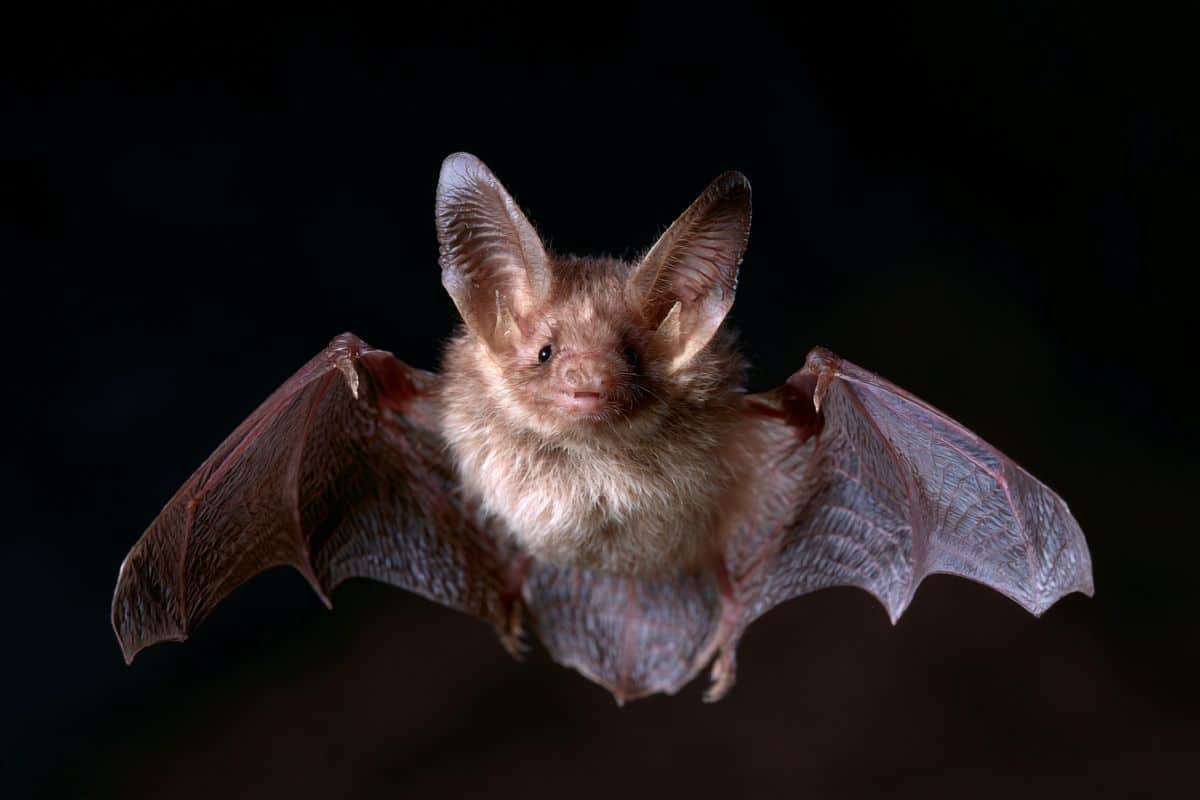
Summary: Researchers discovered that greater Japanese horseshoe bats adjust and align their echolocation call frequencies when living in colonies to prevent acoustic interference.
The new study demonstrates how wild bats introduced to a captive colony asymmetrically shift their constant-frequency second harmonic (CF2) calls upward. Rather than separating their frequencies to avoid overlap—a strategy seen in other bat species, these horseshoe bats converge on a shared frequency band.
This acoustic alignment allows colony members to maintain and share a “silent spectral window,” a clutter-free frequency range essential for detecting Doppler-shifted echoes from fluttering insect prey.
Key Facts
- The Flashlight Analogy of Interference: Just as multiple people shining different colored flashlights in a dark cave make it impossible to track a gemstone’s reflection, overlapping echolocation calls create acoustic clutter for bats navigating and hunting together.
- Constant-Frequency and Doppler Shift: Greater Japanese horseshoe bats use combined constant-frequency (CF) and frequency-modulated (FM) pulses, utilizing an anatomical acoustic fovea to detect insect wing “glints” while compensating for Doppler shifts caused by motion.
- Asymmetric Frequency Convergence: Over a 16-year dataset spanning 15 capture events (2008 to 2024), researchers observed that wild-caught bats with lower initial CF2 frequencies shifted their calls upward when integrated into a captive colony, while higher-frequency bats remained stable.
- Sharing the Silent Spectral Window: By shifting upward, lower-frequency bats avoid acoustic conflict with higher-frequency colony mates, allowing all individuals to utilize a shared, clutter-free frequency band above the CF2 threshold to detect prey.
- Value of Long-Term Bioacoustic Data: The discovery relied on sustained, multi-year laboratory recording efforts tracking individual bat calls over generations of colony mixing.
Source: Doshisha University
Imagine searching for a gemstone in a dark cave; you use a flashlight, looking for a rainbow-colored glint in the darkness. Now, imagine ten other people in the cave with you, using different colored flashlights at the same time. Suddenly, you can no longer tell which light is coming from your gemstone, which light is from another flashlight, or which light is coming from a reflection of another unknown object.
That is what echolocation with multiple, overlapping frequencies would be like. But now, imagine if every person in the cave was using a flashlight in the same color. The glint from the gemstone would be much easier to see.

A new study reveals that greater Japanese horseshoe bats use a similar strategy; they align their echolocation call frequencies within a colony to avoid interference and better ‘see’ their surroundings.
Bats are an ecologically important species, responsible for pest control, pollination, and seed dispersal. They use echolocation to ‘see,’ emitting ultrasonic sound waves that bounce back off objects and give them an idea of what, where, and how fast these objects are.
Understanding bat echolocation is essential for revealing how animals perceive and navigate their environment. Moreover, the sophisticated sensing strategies of bats have inspired advances in bio-inspired sensing technologies and autonomous robotic systems. For example, sonar technologies are constantly being improved based on observations from echolocating species like bats.
Most bats use frequency-modulated (FM) acoustic pulses, i.e., they vary the frequency of single sound waves in their calls. However, some bat species, such as the greater Japanese horseshoe bat (Rhinolophus nippon) use unique pulses that include both FM components and constant-frequency (CF) components. The bats detect and identify prey through ‘glints’, periodic modulations in the amplitude and frequency of the reflected CF component of the echolocation call.
Additionally, these bats have a special anatomic feature called the acoustic fovea that shows exceptional sensitivity to a narrow frequency band that is centered on the second harmonic CF component (CF2) of the echolocation pulse. CF-FM bats adjust the CF component of their echolocation calls to ensure that the CF2 component falls within the acoustic fovea to compensate for a phenomenon known as ‘Doppler shift,’ where the frequency recorded by a moving observer or emitted by an object in motion changes based on their speed and direction of motion.
Now, what happens when you mix a group of bats with overlapping CF2 frequency bands? This was the driving question behind a new study, published in Journal of Comparative Physiology A.
The study, authored by Haruhito Matsumoto, Soshi Yoshida, and Shizuko Hiryu of Doshisha University, describes how, when wild greater Japanese horseshoe bats are mixed with captive colonies, they modify their CF calls in an unusual way.
“Unlike some other echolocating bats that separate their call frequencies to avoid interference, these horseshoe bats appear to converge on a shared frequency. Building on our previous study showing that they use a ‘silent spectral window’ to detect Doppler-shifted echoes from fluttering prey, we propose that this convergence allows colony members to maintain and share that window,” explains Dr. Soshi Yoshida.
Elucidated in a previous work, ‘silent spectral window’ refers to a clutter-free band of frequencies above a given threshold that allows for more effective sensing of prey. Here, the horseshoe bats adjust their echolocation frequencies so that most background acoustic interference remains below the threshold. Since Doppler-shifted acoustic glints from fluttering prey occur within this clutter-free frequency band, the silent spectral window enables reliable detection of these prey signals.
For their study, the researchers captured wild horseshoe bats across 15 different time points and measured their CF2 frequencies. The bats were then introduced into a captive colony of the same species of bats, and their CF2 frequencies were measured again after a month.
From 2008 to 2024, data was collected from wild and captive bats across 15 capture events to obtain information on convergence. Significantly, the researchers observed an asymmetric pattern to the convergence; lower-frequency individuals (typically, wild-caught bats) strongly shifted their frequencies upwards during convergence. When there were no initial differences in frequency between the wild group and the captive group, no such convergence occurred.
“This observation was only possible because past and present laboratory members carefully recorded the calls of individual bats over many years. It highlights the scientific value of long-term data accumulated through sustained effort,” says Dr. Yoshida.
The upward shift displayed by lower-frequency individuals supports the idea that convergence is a strategy employed by horseshoe bats to share a silent spectral window above the CF2 frequency. Essentially, when lower-frequency bats received their echolocation bounce backs from prey (i.e., glints), they were in the same range as the higher-frequency calls of other bats in the colony.
By shifting their frequencies higher, the lower-frequency bats could avoid that conflict. At the same time, the higher-frequency bats already enjoyed a clear window for their glints and so had less of a driving force to adjust their calls.
Overlap in echolocation frequency is a major challenge to sensing in same-species colonies of bats, but research on acoustic interference in mixed populations of same-species bats is scarce. This study helps fill that gap and provides new insight into how bats interact at an individual level and achieve high-sensory performance in echolocation.
Key Questions Answered:
A: They emit constant-frequency (CF) pulses and listen for “glints”, periodic amplitude and frequency modulations caused by the fluttering wings of insect prey. Their inner ears feature an acoustic fovea finely tuned to a narrow frequency band (CF2) to process these echoes despite their own movement.
A: While some bat species separate their call frequencies to avoid jamming, greater Japanese horseshoe bats converge upward to share a “silent spectral window.” This clutter-free frequency band allows them to maintain high-sensitivity prey detection without interference from neighboring colony members.
A: By measuring CF2 frequencies across 15 capture events between 2008 and 2024, researchers found the convergence is strictly asymmetric. Only lower-frequency bats shifted their calls upward to match higher-frequency peers; when groups had identical initial frequencies, no shift occurred.
Editorial Notes:
- This article was edited by a Neuroscience News editor.
- Journal paper reviewed in full.
- Additional context added by our staff.
About this auditory neuroscience research news
Author: Marika Kawano
Source: Doshisha University
Contact: Marika Kawano – Doshisha University
Image: The image is credited to Neuroscience News
Original Research: Open access.
“Greater Japanese horseshoe bats (Rhinolophus nippon) gradually converge their echolocation call frequency to colony members” by Haruhito Matsumoto, Soshi Yoshida & Shizuko Hiryu. Journal of Comparative Physiology A
DOI:10.1007/s00359-026-01821-5
Abstract
Greater Japanese horseshoe bats (Rhinolophus nippon) gradually converge their echolocation call frequency to colony members
In bats using CF-FM echolocation calls, CF component frequencies vary among colonies, across geographic regions, and between sexes. In this study, we investigated frequency changes of the second harmonic of the CF component (CF2), which is the dominant harmonic in the multi-harmonic echolocation calls, that occur following the mixed housing of resident and wild-caught populations of greater Japanese horseshoe bats (Rhinolophus nippon).
By focusing on individual-level frequency adjustments in the context of colony mixing, we tracked CF2 frequencies in a total of 101 individuals across 15 capture events over a one-month period. CF2 frequencies initially differed between the resident and wild-caught populations.
These intergroup frequency differences gradually decreased after mixing, accompanied by a reduction in overall variability within the colony. This convergence was achieved asymmetrically, such that bats with lower CF2 frequencies adjusted their frequencies upward, while bats with higher CF2 frequencies individuals showed little or no change.
No systematic changes were observed when initial frequencies did not differ between two groups. Echolocation in group contexts would be expected to suffer from severe acoustic interference caused by overlapping calls from conspecifics; however, CF bats instead tend to converge on a shared CF frequency.
Because this convergence was primarily driven by individuals using lower frequencies, it may be interpreted as a strategy to allow individuals to share a “silent spectral window” above the CF2 frequency, which is critical for Doppler-based detection.
In other words, for CF bats, in which the use of Doppler information is fundamentally important, frequency convergence may function as a strategy for avoiding acoustic interference.