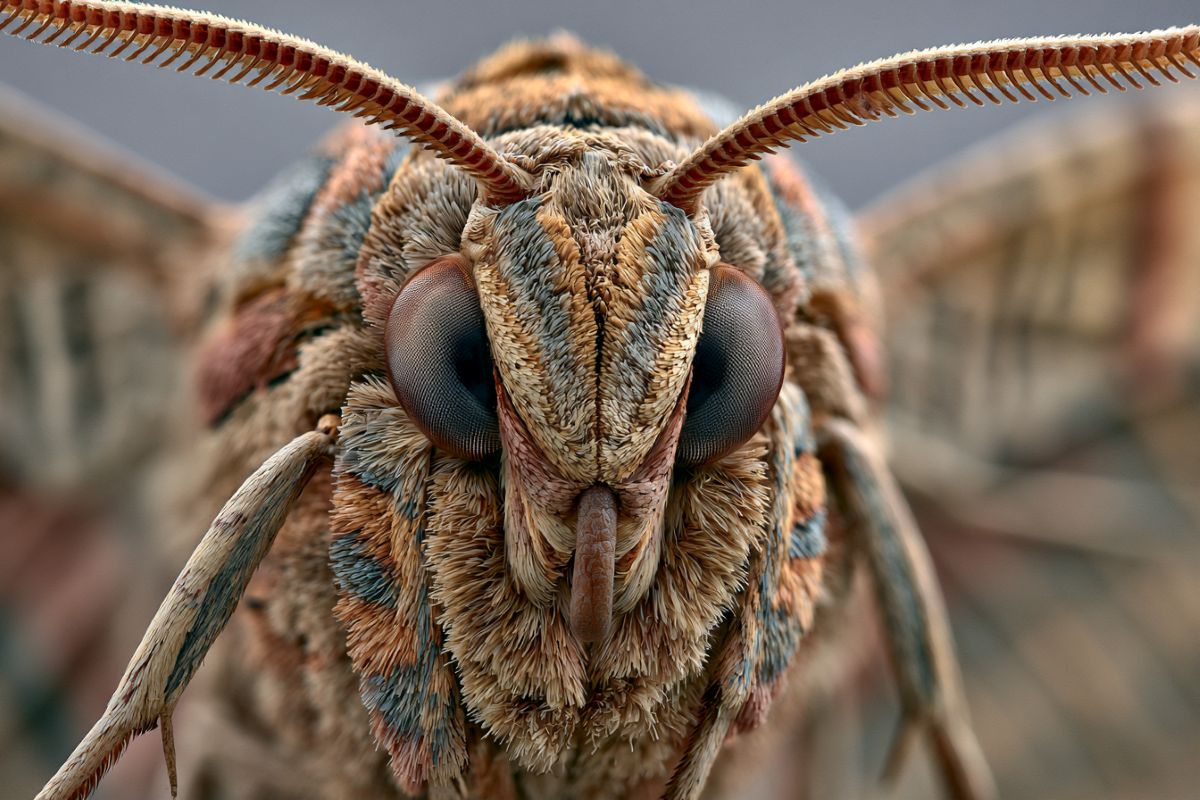
Summary: Using high-speed videography and automated computer-vision pose estimation, the research team discovered that individual hawkmoths show a consistent spatial preference, placing the tip of their proboscis predominantly to either the left or right of their body’s midline during flower exploration.
Crucially, this motor bias is tightly coupled to a dominant eye, forming an integrated eye-proboscis-target control axis. This hardwired behavioral shortcut allows insects with miniature brains to execute complex visual-motor control without incurring heavy computational processing demands.
Key Facts
- Lateralization of Unpaired Appendages: Hummingbird hawkmoths demonstrate clear motor lateralization in an appendage that exists as a single, central organ (the proboscis), extending it preferentially to either the left or right of the midline during foraging.
- Innate Behavioral Shortcut: Side preferences are stable and present from the very first flower visit, proving that proboscis lateralization is an innate trait rather than a learned motor habit.
- Integrated Eye-Proboscis Control Axis: Proboscis placement is strictly aligned with the visual field of a dominant eye, creating a unified visuo-motor axis that guides spatial exploration.
- Rigid Behavioral Conservation: When researchers experimentally occluded part of the dominant eye, hawkmoths did not shift their proboscis to the unobstructed eye; instead, they adjusted their entire body position relative to the flower to maintain their original eye-proboscis alignment strategy.
- Computational Optimization: Aligning an unpaired sensory-motor tool with a dominant eye reduces the neural processing required to calculate spatial trajectories, offering a highly efficient mechanism for small insect brains.
Source: University of Konstanz
Most people have a preferred hand for tasks such as writing or grabbing a cup of coffee. The same applies to the feet – for example, when playing soccer. Similar preferences are also found across many other animals: birds, octopuses, and insects, among others, often favor either their left or right leg, arm, or antenna when performing specific actions. This so-called lateralization is widespread throughout the animal kingdom and occurs in organisms with a wide variety of nervous systems.
But what about appendages that an animal has only one of – such as our tongue or an elephant’s trunk? Even in these cases, lateralization can occur.

In their latest study published in PNAS, research led by Lochlan Walsh and Anna Stöckl from the University of Konstanz demonstrated one such example: Their findings reveal that hummingbird hawkmoths – a day-active moth species that suckle nectar from flowers like their namesakes – have a preferred side to which they extend their tongue-like proboscis while inspecting flowers for nectar.
This may be a solution that nature has developed to enable precise control of actions even in organisms with comparatively simple nervous systems.
A moth’s version of handedness
To determine the side to which hummingbird hawkmoths extend their long proboscis, the researchers presented the insects with artificial flower surfaces that the animals approached and inspected. Using high-speed cameras and computer-vision tools, they were then able to reconstruct the proboscis movements in detail and track them relative to the rest of the body.
The researchers found that some individuals tended to place the tip of their proboscis predominantly to the left of their body’s midline while inspecting a flower, whereas others showed a preference for the right side. The strength of this side preference varied between individuals, much as the strength of handedness does in humans. What is more, the individual side preference was already evident from the beginning of the experiment rather than emerging with increasing experience.
“This suggests that proboscis lateralization is an innate trait and that it plays an important role in guiding the moths’ flower-inspection behaviour,” says Stöckl.
Touch where you look
In a further step, the researchers simulated the animals’ visual field during flower exploration. They found that hummingbird hawkmoths not only had a preferred side for placing their proboscis, but also a dominant eye for viewing the part of the flower they were touching. The side of this dominant eye consistently matched the side on which the proboscis was preferentially positioned.
“Insects have quite small brains. Aligning the proboscis with the visual field of the dominant eye can save valuable processing capacity when controlling behavior. Rather than constantly recalculating a movement from every possible angle, the animal can rely on a familiar side of its body to guide its actions”, Walsh explains.
What came as a surprise was that the alignment of the proboscis with the visual field of the dominant eye was maintained even when part of that eye was experimentally occluded.
“Humans or birds would adapt in such a situation by moving their limb into the visual field of the unobstructed eye. Hummingbird hawkmoths, by contrast, adjust their body position on the flower so that they can view it with the uncovered portion of the dominant eye and preserve their original eye-proboscis strategy,” Walsh says.
As a result of the limited computational capacity of their brains, the moths seem to depend on this efficient coordination of the dominant eye and the proboscis.
Taken together, the findings show that precise, flexible behavior does not require a large brain.
“Instead, animals can rely on efficient shortcuts built into the relationship between the body, the senses, and movement,” Stöckl explains.
In hummingbird hawkmoths, one such shortcut is the eye and proboscis working as a coordinated unit.
“Each moth solves the challenge of flower inspection through the side preferences of its own body. Our study therefore suggests that lateralization may be one of nature’s ways of simplifying difficult tasks – whether that task is reaching for a coffee cup or using the proboscis to search for nectar while hovering in front of a flower.”
Key Questions Answered:
A: “Handedness” is usually studied in paired limbs (like human hands or bird feet). Finding consistent lateral biases in a single, centrally located organ like the proboscis shows that motor lateralization can govern unpaired appendages, revealing a universal strategy for spatial movement control.
A: Calculating movement trajectories from every possible angle requires significant neural processing power. By pairing the proboscis with a fixed dominant eye, the moth uses a simplified visuo-motor shortcut, allowing rapid and precise targeting while conserving limited brain capacity.
A: Unlike vertebrates, which typically adapt by switching to their open eye or moving their limb into the clear visual field, the hawkmoths re-oriented their entire body on the flower to keep using the unblocked portion of their dominant eye, demonstrating how deeply conserved this visuo-motor axis is.
Editorial Notes:
- This article was edited by a Neuroscience News editor.
- Journal paper reviewed in full.
- Additional context added by our staff.
About this neuroscience research news
Author: Helena Dietz
Source: University of Konstanz
Contact: Helena Dietz – University of Konstanz
Image: The image is credited to Neuroscience News
Original Research: Open access.
“Conservation of a lateralized visuomotor axis in hawkmoth proboscis probing” by Lochlan Walsh, Sören Magnus Kannegieser, Anna Lisa Stöckl. PNAS
DOI:10.1073/pnas.2609365123
Abstract
Conservation of a lateralized visuomotor axis in hawkmoth proboscis probing
Lateralization of behavior, including motor control and sensory processing, is widespread across bilaterians. In visually guided tasks it often manifests as an axis aligning eye, appendage, and a target within a shared reference frame, such as eye-hand coordination in humans or eye-beak coordination in birds.
While studied intensively in a few vertebrate systems, whether similar control principles apply to invertebrates, and more generally, how sensory and motor lateralization are linked mechanistically, remains unclear.
Using the proboscis inspection behavior of hummingbird hawkmoth Macroglossum stellatarum as a model for visual appendage guidance, our study provides evidence for lateralized visuo-motor control in an invertebrate. C
ombining high-speed videography and markerless pose estimation, we establish the underlying control axis between the hawkmoths’ unpaired appendage and its eye. We demonstrate that individuals displayed stable, idiosyncratic proboscis lateralization, which was tightly linked to their instantaneous viewing angle of visual targets, thus forming a persistent eye–proboscis–target axis. This axis also had functional consequences for feature-targeting.
Assessing the sensory–motor plasticity using monocular occlusion, we found that moths preserved their lateralized visuo-motor geometry by adjusting body posture during flower inspection.
Our findings suggest convergent control principles with vertebrate models of lateralized visual appendage guidance, while highlighting stark differences in sensory–motor plasticity, thus adding to our general understanding of how lateralization shapes control strategies across nervous systems.