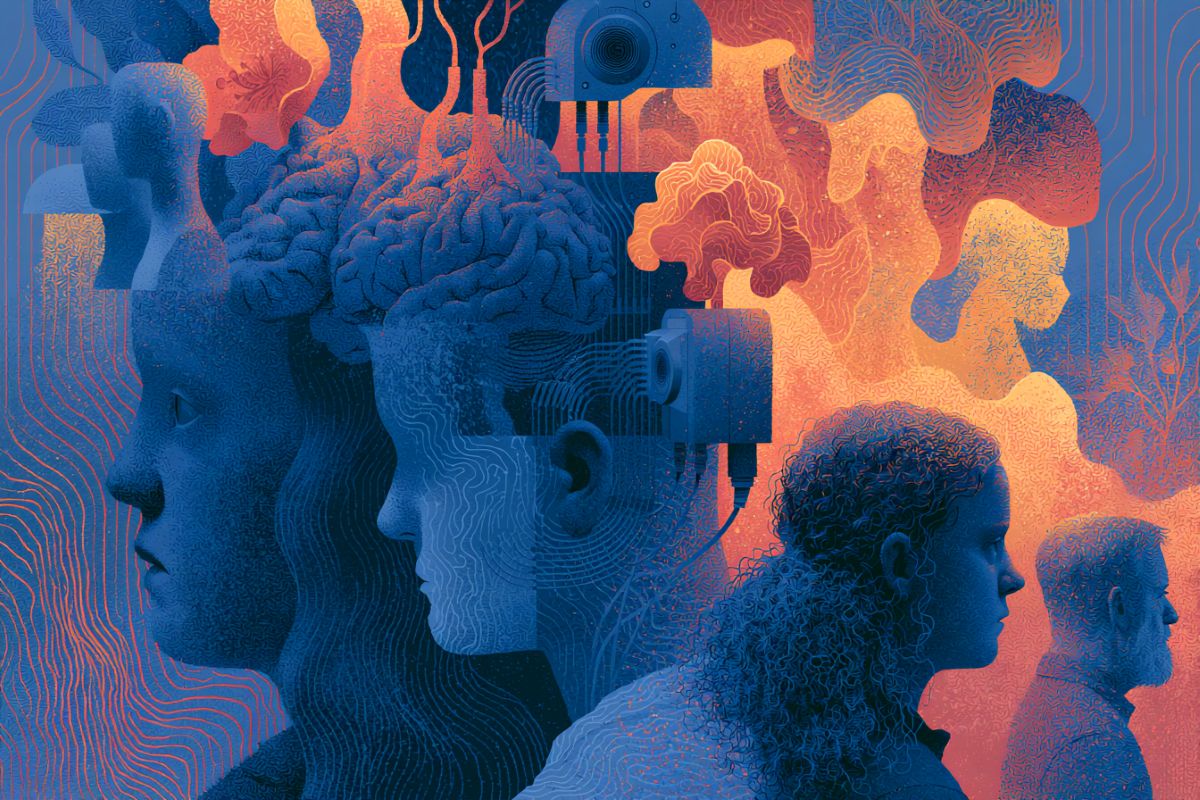
Summary: A perspective review outlines a roadmap for next-generation cognitive brain-computer interfaces (BCIs). Expanding BCI technology beyond motor paralysis to psychiatric conditions like depression, anxiety, PTSD, and OCD requires shifting from static motor cortical decoding to dynamic, multi-region network tracking.
The study emphasizes merging real-time intracranial decoding with adaptive neuromodulation to build closed-loop systems capable of detecting emerging psychiatric states and responding with precisely timed neurostimulation.
Key Facts
- Motor vs. Cognitive Paradigm Shift: Motor BCIs rely on compact, well-mapped motor cortex populations. Cognitive BCIs must decode diffuse, multi-regional brain networks that dynamically reorganize and alter signal meaning across varying contexts.
- Merging Read and Write Approaches: Cognitive BCIs unify two historically separate disciplines: BCI research (focused on reading/decoding brain signals) and clinical neuromodulation (focused on writing/stimulating tissue) into an integrated, closed-loop loop.
- Real-Time State Detection: Next-generation cognitive BCIs are designed to detect emerging dysfunctional states (e.g., depressive dips, anxiety spikes, compulsive loops) in real time and deliver adaptive, micro-timed electrical or neurochemical modulation.
- Existing Clinical Building Blocks: The foundational hardware already exists across clinical and research environments, including multi-site intracranial recording, adaptive deep brain stimulation (DBS), and high-resolution neurochemical sensing.
- Vast Market & Clinical Expansion: Patient populations for psychiatric and cognitive conditions dwarf those for severe paralysis, driving growing interest from academic institutions, neurotech startups, and commercial BCI companies.
Source: Mount Sinai Hospital
Brain-computer interfaces (BCIs) have made remarkable progress restoring movement and speech in people with paralysis.
While brain-computer interface technology thus far has largely focused on decoding motor function, the disorders responsible for the greatest global burden of brain disease—including depression, anxiety, post-traumatic stress disorder, and obsessive-compulsive disorder—are fundamentally disorders of cognition: how we attend, remember, decide, and regulate emotion.
As researchers seek to expand the clinical potential of BCIs, a new review argues that treating cognitive disorders will require fundamentally different approaches than the current BCI motor applications.
In a perspective published in Trends in Cognitive Sciences, Ignacio Saez, PhD, Director of the Laboratory for Human Neurophysiology at the Icahn School of Medicine at Mount Sinai, outlines a roadmap for developing next-generation “cognitive brain-computer interfaces.”
He explains that decoding thought is vastly different from decoding movement. While movement is represented in a compact, stable, well-mapped patch of brain, cognition is not.
Brain activity underlying attention, memory, and emotion is spread across many regions, within networks that reorganize from moment to moment; thus the same brain signal can mean different things in different contexts. Recognizing these differences is what will allow scientists and engineers to borrow and adapt the right tools from motor BCI for this new cognitive application.
“Brain-computer interfaces have made extraordinary progress restoring movement and speech and I believe the field is at an inflection point where advances in intracranial recording, decoding, and clinical neuromodulation now make it plausible to build BCIs that target cognitive, rather than motor functions,” said Dr. Saez, Associate Professor of Neuroscience, Neurosurgery and Neurology at the Icahn School of Medicine.
“This review reframes the next frontier – cognition – as a distinct scientific and engineering challenge that will bring together two approaches that have historically worked more or less separately: BCI research, which has been focused on reading the brain; and clinical neuromodulation, which has focused on stimulating it. Cognitive BCIs will require merging both into a closed-loop system.”
These systems must detect dysfunctional brain states as they emerge and respond with precisely timed, adaptive neurostimulation. Dr. Saez describes the scientific advances—and remaining challenges—needed to make this vision a reality.
He explains that many of the necessary building blocks—including intracranial brain recording, adaptive neurostimulation, and high-resolution neurochemical sensing—already exist in clinical and research settings. Integrating these technologies into intelligent, closed-loop systems represents the next major challenge for the field and could ultimately enable more precise, personalized treatments for serious brain disorders.
The push toward cognition also comes as commercial interest in brain-computer interfaces intensifies. Companies that have driven much of the recent progress in motor and speech BCIs are increasingly looking to cognitive applications as the field’s next frontier, where the addressable patient populations—spanning depression, anxiety, PTSD, and other common psychiatric and neurological conditions—are far larger than those for paralysis.
Dr. Saez notes that translating these advances from the laboratory into approved therapies will depend not only on scientific progress but also on close collaboration among academic researchers, clinicians, and industry to build the hardware, algorithms, and regulatory pathways that clinical-grade cognitive BCIs will require.
Key Questions Answered:
A: Motor function is localized in well-mapped brain regions like the motor cortex, where neural signals directly correlate with physical actions (e.g., reaching or flexing). Cognitive processes like emotion and attention are distributed across multiple interconnected brain networks that constantly reshape themselves. The same brain signal can signify completely different mental states depending on context, making simple motor-decoding algorithms ineffective.
A: Traditional deep brain stimulation (DBS) often delivers continuous, fixed electrical pulses regardless of what the patient’s brain is doing. A closed-loop cognitive BCI constantly monitors brain activity in real time, uses machine learning to detect when a patient is entering a harmful mental state (such as a severe anxiety loop or depressive crash), and delivers precisely calibrated stimulation only when necessary.
A: The individual building blocks already exist: high-density intracranial recording electrodes, adaptive neurostimulators, and fast-scan cyclic voltammetry for real-time neurochemical sensing (measuring neurotransmitters like dopamine and serotonin). The primary engineering hurdle is combining these hardware streams into a miniaturized, ultra-low-latency implanted system running adaptive contextual algorithms.
Editorial Notes:
- This article was edited by a Neuroscience News editor.
- Journal paper reviewed in full.
- Additional context added by our staff.
About this neurotech and psychology research news
Author: Elizabeth Dowling
Source: Mount Sinai Hospital
Contact: Elizabeth Dowling – Mount Sinai Hospital
Image: The image is credited to Neuroscience News
Original Research: Open access.
“The emerging field of cognitive brain–computer interfaces” byIgnacio Saez. Trends in Cognitive Sciences
DOI:10.1016/j.tics.2026.06.012
Abstract
The emerging field of cognitive brain–computer interfaces
Advances in neural recording and decoding are expanding brain–computer interfaces from motor and language restoration to cognitive functions.
Emerging cognitive brain–computer interfaces aim to monitor or alter internal states such as attention, memory, emotion, and decision-making.
There are significant differences in the neural basis of cognitive versus motor/language processes, which will require different approaches in cognitive brain–computer interface.
Clinical applications represent a natural starting point for cognitive brain–computer interface development, given the predominance of cognitive deficits in psychiatric disorders.
Multimodal data, layered behavioral labels, large datasets, and foundation models provide a potential pathway toward the methodological development of cognitive brain–computer interfaces.
Eventually, closed-loop devices, building on motor decoding and clinical neuromodulation foundations, will be essential for cognitive brain–computer interfaces.
Abstract
Brain–computer interfaces (BCIs) have achieved transformative success in restoring movement and communication. However, extending these approaches to decoding or recovery of cognitive function, such as attention or memory, poses fundamentally new challenges.
Cognitive BCIs will need to contend with distributed and dynamic neural processes that differ sharply from the more localized, stable representations underlying motor and language control, imposing new technical and conceptual demands.
Conversely, neuromodulation, long used in neurological and psychiatric therapies, offers a complementary methodological path and initial translational applications through causal modulation of cognitive circuits.
Integrating these approaches into adaptive, closed-loop systems could allow cognitive BCIs to restore mental function and bridge systems neuroscience and next-generation neurotherapeutics capable of monitoring and shaping human cognition in real time.