Summary: A new study successfully mapped the functional blueprint of a living forebrain in real time using larval zebrafish. The team discovered that the fish forebrain organizes sensory signals using an identical spatial ladder to humans: sorting distinct streams at the entrance and combining them deeper inside into multi-sensory coincidence networks.
This proves that the computational logic required to stitch separate senses into a single, seamless world is a universal evolutionary rule, not a mammalian accident.
Key Facts
- The Universal Perception Paradox: Our physical reality lands on our bodies in fragmented channels, light through eyes, soundwaves and mechanical vibrations through separate receptors. The brain must continuously merge these disparate tracks into a single, unified experience.
- The Mammalian Receptionist: In humans and mice, this sensory sorting falls to a central subcortical structure called the thalamus. The thalamus receives raw data, separates it cleanly by sensory modality (vision to one hub, sound to another), and routes it up to distinct rooms in the cerebral cortex to be processed and integrated into conscious thought.
- The Pre-Glomerular Complex (PG): The Yaksi lab discovered that zebrafish utilize an entirely different anatomical structure called the preglomerular complex (PG) as their primary sensory doorkeeper. Fed by the midbrain, the PG replicates the exact same sorting method as our thalamus, channeling light signals to one zone of the forebrain and water vibrations to another.
- The Multi-Sensory Convergence Ladder: As signals ascend deeper into the fish’s forebrain, specifically into a structure called the pallium, single-sense neurons give way to multi-sensory cells. This step-by-step progression creates a functional processing hierarchy or “ladder” running from the back of the forebrain to the front.
- Coincidence Detection Cells Found: Deep within the pallium, researchers isolated specialized neurons that remain completely silent when presented with a flash of light alone or a water tremor alone. These cells activate only when both light and vibration occur simultaneously, firing intensely to bind the two separate events into a singular cognitive experience.
- The Logic of Adaptation: While basic processes like moving, chewing, or dodging reflexively do not require a forebrain, the complex integration happening in the pallium is designed for unpredictable environments. When the world stops behaving as expected, this cross-sensory calculation engine allows the animal to troubleshoot, learn causal links, and adapt dynamically.
Source: NTNU
Line up the brains of a fish, bird and a mammal, and something unexpected comes up. You do not see three different answers to the problem of making sense of the world. You see one answer, tilted three different ways.
“You can really see it’s almost like a continuum,” says Emre Yaksi, a professor at the Kavli Institute for Systems Neuroscience in Trondheim. Read across decades of anatomy, the same two ancient pathways carry the world into the forebrain of all these animals.

What changes from one to the next is mainly which route does more of the work. Evolution built these brains from different parts, in creatures that parted ways hundreds of millions of years ago. It kept arriving at the same answer anyway.
That is the puzzle the Yaksi lab set out to chase. If animals this far apart on the tree of life keep landing on the same arrangement, perhaps the arrangement is no accident. Perhaps there are organisational rules deep enough that a fish and a person, for all the differences between them, are bond by the same ones. The Yaksi lab’s new study, published in Science with Dr Anh-Tuan Trinh as the first author, is an attempt to catch one of those rules at work in the least likely animal there is.
The problem every brain must solve
Let’s start with what the brain is up against, because everything else follows from it.
Our perception of the world does not arrive whole: it comes in through separate senses. Light through our eyes, sounds and vibrations through others. Each pouring into our brains via on its own pathway. And yet you never experience a jumble of channels. You experience one seamless world. Somewhere inside, the brain has to take those separate streams and merge them back into a single scene. How does the brain arrange itself to manage that?
It helps to picture a house. The senses arrive at the door, and someone has to meet them and show each one where to go. In a mammal, that receptionist job falls to a structure called the thalamus. It receives the incoming senses and sends each to its own room, vision to one, sound to another, keeping them apart at first. Only deeper in the house, in the rooms we call the cortex, do the senses meet again, mingle and get compared, until somewhere in the innermost rooms they become thoughts, perceptions, decisions.
That layout, senses sorted at the entrance and combined in different ways deeper in, is one of the most dependable designs in vertebrate brain evolution. What Trinh, Yaksi and their co-authors wanted to know was whether a creature on a completely different branch of the family tree builds a similar house.
The room
To watch a brain do this, you first have to keep a fish still and content.
A young zebrafish, not yet three weeks old and less than a centimetre long, is settled into a bed of clear gel beneath a microscope. A small opening is made in the gel near its mouth, so fresh water can flow past and it can breathe easily. The fish is then acclimatised to this small, enclosed world, the way a person might be settled and reassured before an MRI scan.
Then there is the wall of instruments. “You activate a whole bunch of switches,” he says. “It reminds me of the cockpit of an aeroplane, or a spaceship. There are so many buttons everywhere.” He has spent years learning them. “It’s like playing the piano. At first, it’s very hard. Over time you get better.”
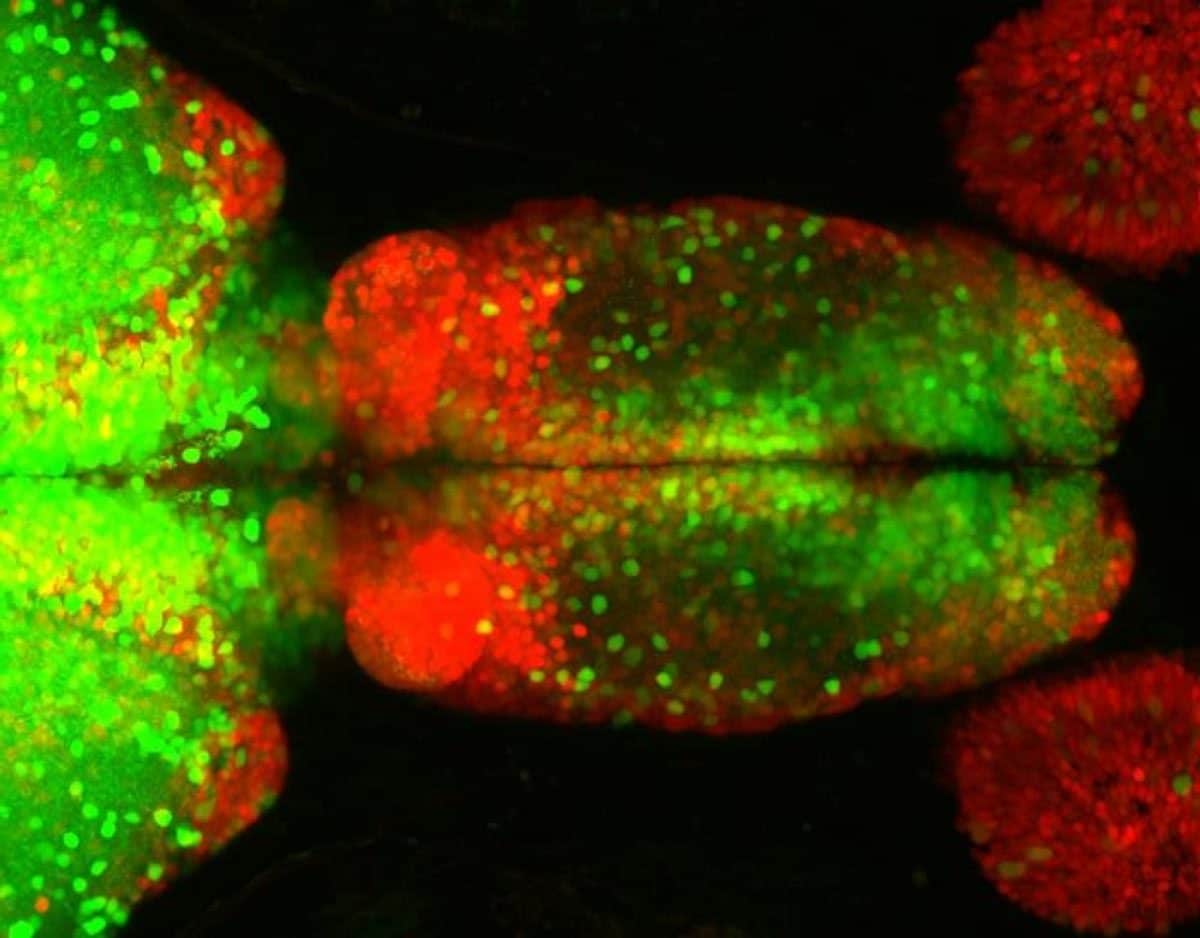
What the buttons buy is something he has never stopped marvelling at. He first saw the activity of a living brain more than a decade ago, as a student. “The first time I saw neurons lighting up here and there, it was just like fireworks in the brain. It was so amazing.” The fish offers something no mammal can. You do not see a small patch of brain, you see the whole of the forebrain at once, end to end, every neuron flaring the instant it fires, in an animal that is alive and sensing. The entire stage lit and behaving, in real time.
Sorting the world
The experiment itself was simple. Trinh showed the fish a flash of red light. He sent a faint buzz through the water. Sometimes one, sometimes the other, sometimes both together, and watched where the brain answered.
Each signal means something to a fish. A flash of light can be as ordinary as a shadow sliding past, a change in the surroundings worth noticing. The buzz is more pointed. Fish can sense movements in the water, and it is sensitive enough to feel the smallest vibrations. “If a predator comes towards a fish, there’s a lot of water movement,” Trinh says. The lab’s gentle tremor is subtler than that, less an attack than an ambush. “It’s really like a surprise signal. Like if somebody sneaks up and taps you on the back. That’s the kind of signal we gave the fish.”
When the team traced where these signals land, they found the fish keeps a different doorkeeper than we do. It is not the thalamus that meets the senses at the entrance, but another structure altogether, fed from the sensing centres of the midbrain. The researchers call it the PG, which is short for preglomerular complex. PG does the same tidy work. It takes the world in and passes it onward sorted, light towards one region of the forebrain, vibration towards another, each stream still clean and separate. The same first rooms, in a different house.
The cells that wait
But the fish’s forebrain does not simply hand the senses along. It works on them, and the deeper Trinh looked, even stranger the cells became.
The plain, single-sense neurons gave way to cells that answered to both light and vibration, the two streams starting to merge. And then, further in, he found a type of neuron he had not been looking for. It stayed quiet when the light flashed on its own. It stayed quiet when the water trembled on its own. It woke only when the two came together at the same moment, and when it did, it fired harder than either event alone could account for.
Anyone who has stood outside in a storm knows the phenomena these cells are built around. The lightning reaches your eyes a moment before the thunder reaches your ears, and still, you know they both belong to the same event. You feel one storm. Something in your head binds the flash to the crack despite that delay. Here in a fish, the researchers caught cells doing exactly that, registering not the flash, not the crack, but the coincidence that the two arrived together.
Trinh found them not at the microscope but afterwards on his computer, deep in the analysis, and he did not believe them at first. “I was blown away. My first reaction was, is this real or not?” He spent the next few hours running the analysis every way he could think of, trying to make the pattern break. It would not. When he finally accepted it, he sat and did nothing useful for a while. “I literally spent ten minutes just looking at these beautiful plots.”
What he was looking at was a kind of a hierarchy, ‘a ladder’ built across the brain. Towards the back sat the simple cells, each minding a single sense. Towards the front, the cells that combined and compared. Simple answers near the entrance. Stranger ones more difficult to predict the deeper you went. The same climb from sensing to perceiving that runs through our own cortex. What these front cells are finally for, no one yet knows. The team has watched what they do, not what they are used for, and nobody has yet tested how they shape the way the fish behaves. For now, they are neurons that seem to be built to notice when two things belong together, which is the very thing a brain has to manage before it can learn that one thing causes another.
Why a fish should bother
But why should a tiny zebrafish brain resemble ours at all?
Most of what keeps a mammal alive does not happen in the cortex. The cortex is not for chewing, moving or making babies, and it is not even needed to dodge an obstacle in its path. The forebrain is for the moments when the world stops behaving as expected: a moment where a creature has to find a new way through and when nothing pre-built could have prepared for it. And it seems that the pressure to build such a brain structure, a machine for adapting, pushes very different animals towards similar solutions.
This is where Yaksi reaches, of all things, for soup.
“You want to thicken your soup. You can put potatoes and rely on the starch, or you can put flour, and it also works. The solutions are similar, but you do not necessarily need to rely on the same material as long as it functions similarly. Two cooks, different ingredients, one result. Two vertebrate lineages, two different sets of brain parts, one design. Sort the senses, merge them room by room, add in cells that respond to a coincidence, and build upward from there.
Whether the fish inherited this arrangement from a shared ancestor, or arrived at it entirely on its own, is a question the lab is now chasing at the molecular level, comparing the cell types that build the circuit in the fish against those in the mammalian cortex and thalamus. It may turn out the two were assembled from the same raw materials after all. Or the fish may have found its own materials and still ended in the same place. Either way, it is the kind of finding that makes a scientist choose words with care. The fish’s doorkeeper is not our thalamus in disguise, and whether the two share any ancient kinship is a question for work still to come. What the fish shows, plainly, is that the road matters less than where it leads.
The rule in the fish
There is an idea behind the work in Trondheim, that the brain runs on discoverable recipes, organising principles it follows the way a kitchen follows a method, and that if you look closely enough you can read them straight off the living tissue. This study catches one of those recipes in the unlikeliest place of all. Not in a primate, not even a mouse, but in the forebrain of a small, transparent fish.
“I don’t argue that a fish has the equivalent of a mammalian cortex,” Yaksi says. “But a fish has something. It’s the pallium. And it evolved from the same vertebrate ancestors that our human cortices evolved from.” Most of what it does is still in the dark for him, and he says so gladly. The study, he insists, only found the way in. “We just now learned where the world comes in. That is how everything starts.”
But the way in, opens onto something large. If a fish and a person, hundreds of millions of years apart, both take the world in through separate pathways and then stitch it back together by the same logic, then that logic starts to look less like a ‘mammalian accident’ and more like a common rule. Something a brain arrives at again and again, because the task of making sense of a world leaves it little other choice.
A mind, it turns out, can be reached by more than one road. The roads keep ending in the same place.
Key Questions Answered:
A: Senior author Professor Emre Yaksi compares this phenomenon to two different chefs trying to thicken a soup. One chef might use potatoes for starch, while another uses flour; the raw ingredients are completely different, but the final, structural result is identical. Humans and zebrafish parted ways on the tree of life over 400 million years ago, and we build our brains out of different anatomical parts (humans use a thalamus and cortex, while fish use a preglomerular complex and a pallium). However, because we both face the exact same physical challenge, stretching separate lines of sight, sound, and touch into a single, unified picture of reality, evolution independently pushed both lineages toward the exact same structural design.
A: These neurons function as the brain’s internal glue, designed to notice when two completely different events belong to the same real-world occurrence. If you stand in a storm, you see lightning before you hear thunder because light travels faster than sound, yet your brain binds them into one single storm. In the zebrafish, Dr. Trinh discovered neurons that stay totally dark and asleep when the fish only sees a flash of light or only feels a water tremor. They wake up and fire with massive intensity only when the flash and the tremor hit at the exact same moment, proving they are hardwired to register the shared connection between separate senses.
A: This is an incredible technical advantage that zebrafish offer over mammals. The researchers settled a tiny larval zebrafish, less than three weeks old and under a centimeter long, into a specialized bed of clear gel underneath a high-powered microscope, adding a small water passage near its mouth so it could breathe comfortably. Because these young fish are completely transparent, the team didn’t have to cut open a skull or look at a tiny, isolated patch of tissue. Using advanced calcium imaging, they were able to witness the entire forebrain from end to end, watching every single neuron light up like a firework the exact millisecond it fired while the living fish actively processed its world.
Editorial Notes:
- This article was edited by a Neuroscience News editor.
- Journal paper reviewed in full.
- Additional context added by our staff.
About this sensory neuroscience research news
Author: Nina Tveter
Source: NTNU
Contact: Nina Tveter – NTNU
Image: The image is credited to Dr Stephanie Fore, Kavli Institute for Systems Neuroscience
Original Research: Open access.
“Hierarchical sensory processing in zebrafish thalamocortical-like circuits” by Anh-Tuan Trinh, Anna Maria Ostenrath, Ignacio del Castillo-Berges, Fanchon Cachin, Mina Koç, Susanne Kraus, Bram Serneels, Koichi Kawakami and Emre Yaksi. Science
DOI:10.1126/science.aec2171
Abstract
Hierarchical sensory processing in zebrafish thalamocortical-like circuits
Thalamocortical projections shape the functional regionalization and parallel sensory computations across the mammalian cortex. However, the principles of thalamocortical computations in non-mammalian vertebrates remain underexplored.
Here we investigated how the zebrafish pallium, a homolog of the vertebrate cortex, receives and processes sensory information, and how its architecture compares to thalamocortical circuits in other vertebrates. We revealed that the preglomerular complex (PG), a thalamocortical-like pathway, is the primary source of visual and vibrational information to the zebrafish pallium. PG and its pallial projections exhibit sensory-specific and topographically organized responses.
In contrast, pallial neurons display topographically organized hierarchies, ranging from sensory-specific to multimodal and coincidence-detecting nonlinear responses. Our results suggest that hierarchies of sensory transformations across topographically organized thalamocortical-like circuits reflect a convergent principle across vertebrates.