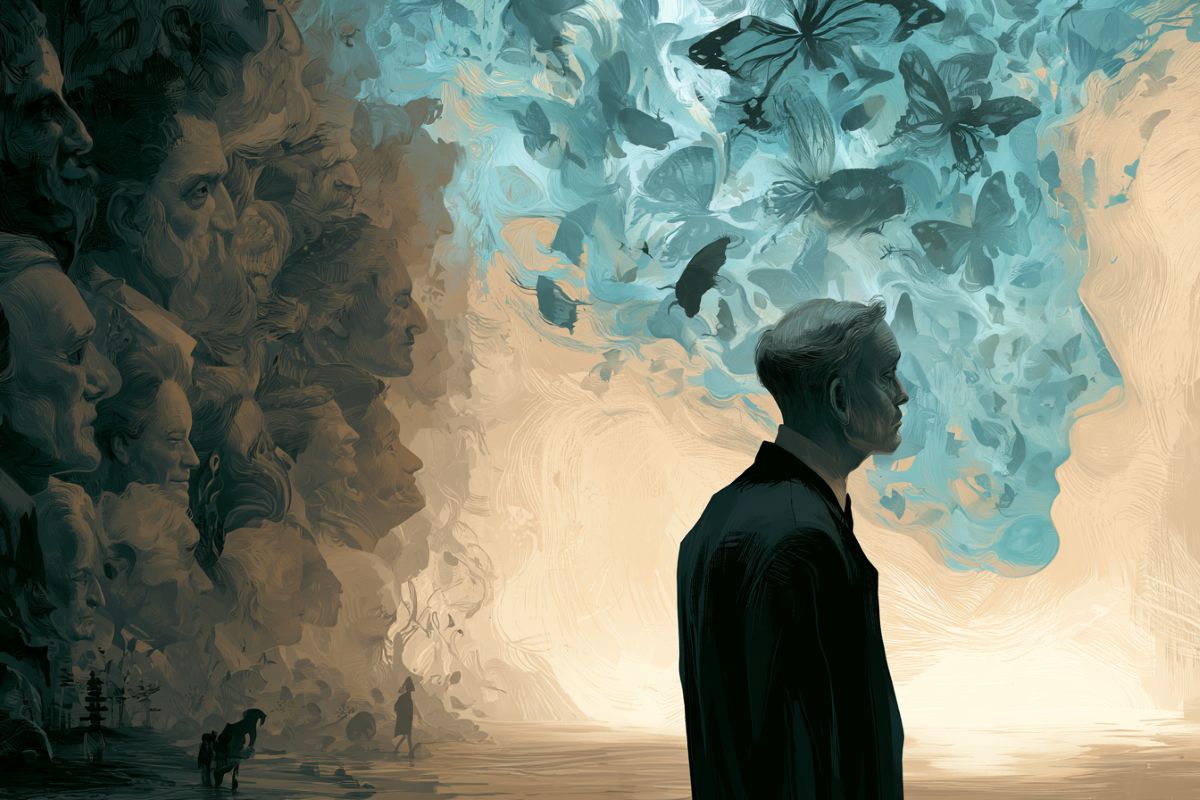
Summary: Researchers argue that aphantasia, the complete inability to voluntarily form mental images, fundamentally shatters Hume’s theory and modern imagistic models of cognition. Individuals with severe aphantasia report a total blind spot when asked to visualize a rainbow or a loved one’s face; they see absolute darkness.
Yet, they reason about geometry, recognize their peers, and process complex abstract moral principles just as fluently as anyone else. By systematically dismantling classical philosophical defenses, the study proves that human thought does not require a sensory theater to function.
Key Facts
- The Humean Bottleneck Disproven: Dr. Uku Tooming notes that if abstract thought strictly required mental imagery, individuals with aphantasia should display profound cognitive deficits when handling geometry, ethics, or mathematics. Empirical evidence proves they do not, indicating that the mind possesses non-visual, non-sensory tracks for complex processing.
- The Failure of Non-Visual Senses: Traditionalists argue that aphantasics might swap out visual pictures for auditory or tactile mental textures. The Tartu philosophers reject this, pointing to total or multimodal aphantasics, who lack sensory imagery across all modalities (sight, sound, touch, and taste) yet retain flawless abstract reasoning.
- The Unconscious Imagery Myth Exploded: The most popular contemporary defense of Hume suggests that aphantasics actually do generate mental images, but process them entirely unconsciously. The paper dismantles this argument, citing recent neuropsychological trials that reveal a total absence of imagery overall, both conscious and unconscious, in severe cases.
- Spatial Tracking Lacks Sensory Richness: While some aphantasics utilize a schematic, blind sense of layout or spatial relationship (like knowing where furniture sits in a dark room without seeing it), this fails to salvage Hume’s theory. Hume’s account dictates that a concept must possess vivid, sensory richness to be understood, a feature spatial grids entirely lack.
- Language Requires Prior Meaning: Traditionalists also suggest aphantasics simply think using the literal words themselves (e.g., reasoning with the word “triangle”). However, within a Humean framework, words are empty vessels; they require a mental image behind them to hold actual meaning, leaving this defense structurally dead.
- More Than a Rare Fluke: The paper forcefully rejects the idea that aphantasia is a harmless, quirky exception to a rule that still applies to the rest of humanity. If aphantasics can think abstractly without pictures, it implies that the fundamental programming of human thought is not inherently imagistic. Treating aphantasia as a mere outlier would assume an implausibly radical split in human psychology, when in reality, the human mind is simply more flexible than 18th-century philosophy assumed.
Source: Estonia Research Council
Most of us, when asked to think about triangles, dogs, or justice, spontaneously conjure up some kind of mental picture: a red triangle drawn on a blackboard, a scruffy terrier, a courtroom scene.
The 18th-century Scottish philosopher David Hume believed this was not just a habit but a necessity. In his view, the mind cannot deal with pure abstractions directly and always needs a concrete mental image to work with first.
To think about triangles in general, you must first picture a specific one. To think about justice, you must mentally replay some vivid scene of fairness or its violation.
But what about people who cannot form mental images at all? People with severe aphantasia draw a complete blank when asked to visualize a rainbow, picture a close friend’s face, or imagine their childhood bedroom. There is simply nothing there.
Yet they can reason about rainbows, recognize their friends, and reflect on their past. And they can engage with abstract concepts like geometry, morality, and mathematics just as well as anyone else.
In a paper published in Neuropsychologia, University of Tartu Associate Professor of Theoretical Philosophy Uku Tooming and Associate Professor of History of Philosophy Roomet Jakapi argue that aphantasia presents a direct challenge to Hume’s theory, and to imagistic models of cognition more broadly. As Tooming puts it: “If abstract thought genuinely required mental imagery, people with aphantasia should struggle to think abstractly. They do not.”
How can abstract thought work without images?
The authors consider and reject several defences of the Humean account. One possibility is that aphantasics perform abstraction using imagery from non-visual modalities, for instance, by relying on auditory or tactile imagery rather than visual images.
However, this is dismissed considering in light of the existence of multimodal aphantasics, who lack imagery across all sensory modalities.
Another defence appeals to involuntary imagery, suggesting that even if aphantasics cannot deliberately form images, they might still rely on imagery that arises spontaneously. This, too, is rejected on the grounds that the kind of imagery required for Humean abstraction is at least partially voluntary and that severe aphantasics lack such imagery.
A further proposal invokes spatial imagery, such as a schematic sense of shape or arrangement without visual detail, for example, grasping the geometric relations of a triangle without picturing one. Yet this defence also fails because such spatial representations lack the sensory richness that Hume’s account takes to be essential.
Finally, the suggestion that aphantasics could perform abstraction by means of language, for instance, by reasoning with the word “triangle” rather than an image, is rejected because the Humean framework requires imagery for understanding abstract concepts that are expressed in language.
The most compelling defence appeals to intact unconscious imagery in aphantasics. On this view, even if individuals cannot consciously visualize a rainbow or a triangle, they may still employ mental imagery unconsciously when engaging in abstract thought.
The paper ultimately rejects this line of response as well, citing limited evidence for unconscious imagery in aphantasia and recent studies indicating an absence of imagery overall, both conscious and unconscious.
More than a philosophical exception
Finally, the paper addresses a metatheoretical response that treats aphantasia as a harmless exception. This approach suggests that Hume’s theory could still hold for most people, even if it does not apply to aphantasics. However, the authors argue that this fails because if aphantasics do not require imagery for abstract thinking, it has broader repercussions for understanding their cognitive processes generally.
It would imply a radical difference between the psychology of aphantasics and non-aphantasics, which is highly implausible. Aphantasia, therefore, cannot be treated as a mere exception, but instead poses a substantive challenge to imagistic accounts of thought.
The findings have implications beyond the history of philosophy. Imagistic theories of cognition remain influential in contemporary cognitive science and philosophy of mind.
Key Questions Answered:
A: David Hume believed that the human mind was essentially an internal sensory theater. In his view, our brains cannot grasp a pure, naked abstraction. If you want to think about “triangles” as a general rule of geometry, Hume argued that your mind must first pull up a slide of a specific triangle, maybe a sharp, blue isosceles triangle on a blackboard. Your mind then uses that specific picture to represent the whole concept. He believed that trying to think about something like “justice” or “beauty” without a vivid internal scene or feeling backing it up was as impossible as trying to see an object that doesn’t exist.
A: They think conceptually and relationally rather than visually. An aphantasic person doesn’t need to see a picture of a terrier to know what a dog is; they understand the definition, the traits, and the factual framework of a dog. In terms of abstract concepts like geometry, they process the logical relations between points and lines as a set of rules and facts, rather than a drawing. Their minds function more like a sophisticated computer database operating via code, text, and structural logic, proving that human understanding can skip the sensory theater entirely and work with pure concepts directly.
A: It means that a lot of modern cognitive science models are still trapped in old, visual-centric assumptions. For a long time, researchers treated aphantasia as a minor, fascinating glitch—an exception to the rule. But Dr. Tooming and Dr. Jakapi prove that you cannot just sweep it under the rug. If an aphantasic person can navigate life, solve complex math, and comprehend deep moral philosophies with a completely dark mind’s eye, it proves that human thought is not fundamentally built on pictures. It forces cognitive science to completely re-evaluate how information is represented in the brain, showing that our mental lives are far more flexible and varied than we ever imagined.
Editorial Notes:
- This article was edited by a Neuroscience News editor.
- Journal paper reviewed in full.
- Additional context added by our staff.
About this aphantasia research news
Author: Mikk Viilukas
Source: Estonian Research Council
Contact: Mikk Viilukas – Estonian Research Council
Image: The image is credited to Neuroscience News
Original Research: Open access.
“Aphantasia as a challenge for Humean abstraction” by Uku Tooming, Roomet Jakapi. Neuropsychologia
DOI:10.1016/j.neuropsychologia.2026.109465
Abstract
Aphantasia as a challenge for Humean abstraction
This paper critically assesses David Hume’s imagistic theory of thought in light of aphantasia. Central to Hume’s theory is the claim that abstraction requires imaginative operations on individual ideas that are mental representations derived from sensory impressions.
We present a challenge to Hume’s account of abstraction by drawing on empirical and philosophical insights about aphantasia. Our argument proceeds as follows. If Hume is right, then abstract thinking depends on being able to imaginatively use individual ideas in a specific way.
However, since individual ideas in Hume’s framework can be identified with mental imagery, individuals with severe aphantasia, who arguably can’t imaginatively use mental imagery, should be unable to engage in abstract thought. Yet, they are able to think abstractly.
Therefore, Hume’s view faces a challenge: abstraction does not seem to require the imaginative use of individual ideas. This reveals a significant limitation not only in Hume’s account, but also in imagistic models of cognition more broadly.