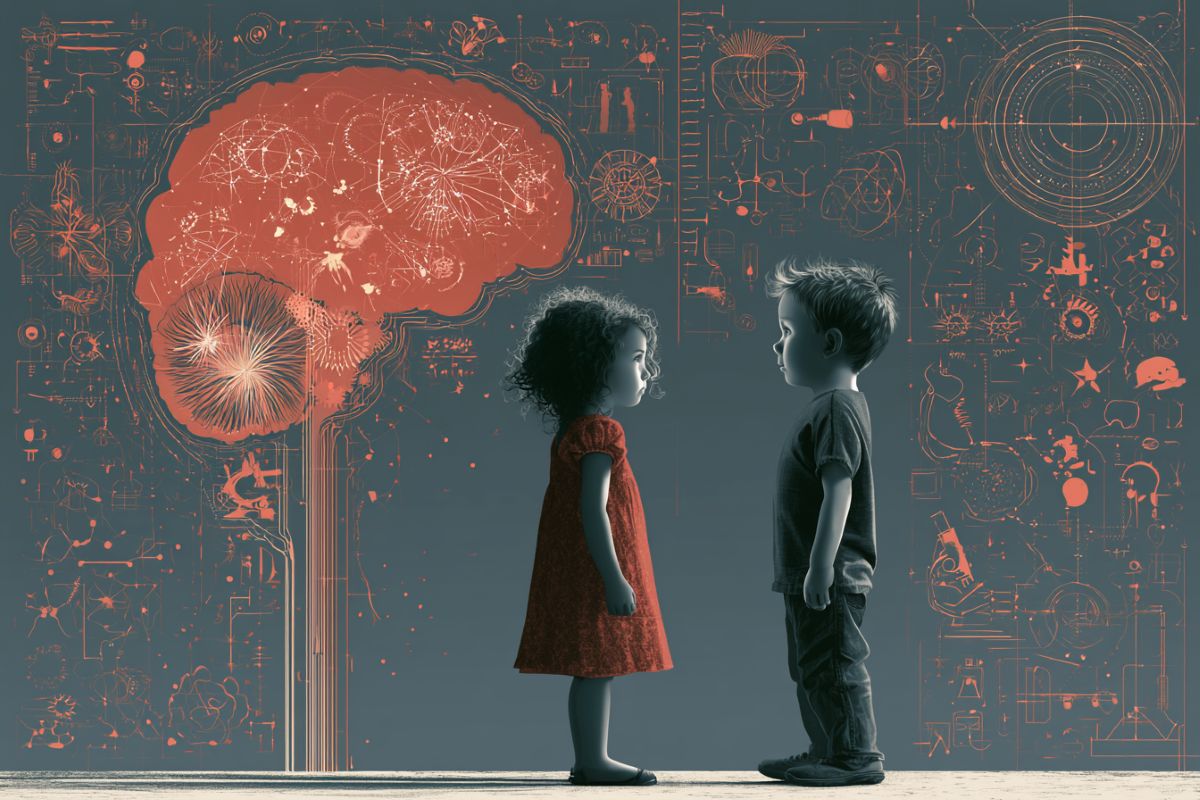
Summary: When does a child begin to reason? When do they develop self-control? Are some mental abilities present from birth, while others are strictly acquired through experience? Questions regarding the fundamental origins of human consciousness have fascinated philosophers, educators, and scientists for centuries. Yet remarkably, empirical cognitive science has focused very little on how ordinary people, across different cultural and linguistic divides, conceptualize the development of the mind itself.
To map this universal psychology, an international research initiative surveyed adults across six diverse nations: Australia, Japan, Mexico, South Africa, the United Kingdom, and the United States. The cross-cultural study discovered a deeply embedded, universally shared cognitive framework.
Regardless of geography or native language, humans do not perceive the developing mind as a random list of separate traits. Instead, they organize mental capacities into a stable, two-dimensional nature-versus-nurture matrix that dictates how societies cross-culturally structure parenting, educational policies, and moral expectations.
Key Facts
- The Shared Framework: Adults across vastly different cultural landscapes share an identical dual-structured mental model tracking how childhood cognitive abilities unfold over time.
- The Perceptual–Experiential Dimension: This universal category encompasses baseline sensory and emotional states, including feeling fear, pain, or hunger. Across all cultures, people view these traits as innate “nature” attributes that emerge early in infancy.
- The Reflective–Evaluative Dimension: This separate developmental category includes high-level cognitive milestones like reasoning, self-restraint, moral judgment, and pride. Society uniformly views these traits as late-emerging, learned “nurture” achievements.
- Data-Driven Clustering: Rather than forcing participants into pre-existing psychological categories, the investigators used un-biased response clustering, allowing the distinct two-dimensional framework to emerge naturally from the raw data.
- Context-Dependent Mind Perception: The study resolves long-standing theoretical debates in mind perception, proving that the brain’s internal model changes based on perspective: comparing humans to robots yields one mental map, while tracking human childhood development yields another.
- Societal Policy Implications: These deeply ingrained intuitive beliefs actively shape daily real-world choices, anchoring parental developmental timelines, localized educational practices, legal definitions of accountability, and public policies surrounding human potential.
Source: Nagoya University
When does a child begin to reason? When do they develop self-control? Are some mental abilities present from birth, while others are acquired through experience? Questions like these have fascinated philosophers, educators, and scientists for centuries.
Yet surprisingly little is known about how ordinary people think about the development of the mind itself. Do people across cultures think about the mind in similar ways? An international study led by researchers from Nagoya University and Rutgers University addresses this question. Surveying adults from six countries, the researchers found that people share a similar picture of how mental abilities develop, even across different cultures and languages.
Participants organize mental abilities into two types: those they think we are more likely to be born with and those they think we are more likely to pick up through experience.
The findings, published in Psychological Science, suggest that even when specific beliefs vary across cultures and experiences, this two-dimensional structure remains stable.
Adults from Australia, Japan, Mexico, South Africa, the United Kingdom, and the United States were presented with 40 different mental capacities and asked: “At what age do you think a person first becomes capable of this?”
Two dimensions of mental development
The results revealed a consistent pattern. Across all six countries, people tended to divide mental capacities into two broad groups. The first included capacities such as feeling fear, hunger, and other basic sensory and emotional experiences. Participants generally believed these abilities emerge relatively early in life. The researchers refer to this group as the Perceptual–Experiential dimension.
The second group included capacities such as reasoning, self-restraint, moral judgment, and pride. Participants consistently believed these abilities emerge later in development. This group was labeled the Reflective–Evaluative dimension.
Rather than starting with a theory of how mental abilities should be categorized, the researchers let patterns emerge from the participants’ responses. Across all six cultures, languages, and survey formats, the same two-dimensional structure appeared, which suggests people around the world may share a common intuitive framework for understanding mental development.
Nature versus nurture
The researchers also explored how people think about the origins of these mental capacities. Participants were asked to judge whether each ability was primarily due to nature (present from birth) or nurture (something we learn through experience). The pattern was clear.
Capacities belonging to the Perceptual–Experiential dimension were generally viewed as more innate, whereas capacities belonging to the Reflective–Evaluative dimension were viewed as more dependent on learning and experience. This is the same split philosophers and scientists have debated for centuries.
Beliefs about how the mind develops shape decisions every day. Parents’ expectations, educational practices, social policies, and public debates about human potential are shaped by assumptions about which abilities are innate and which must be learned.
The findings suggest that people share a consistent mental model of development. They do not think of the mind as a list of separate abilities. Instead, they imagine a developmental journey that begins with perception and experience and progresses toward reflection, evaluation, and self-understanding.
“Another important implication of our findings concerns a long-standing debate in the field of mind perception,” said Xianwei Meng, lead author and associate professor from the Graduate School of Informatics at Nagoya University.
“Previous research has proposed several competing models of how people perceive mental life. Our findings suggest that these models are not necessarily contradictory. Instead, the structure people perceive depends on the perspective they take. When people compare different kinds of entities, such as humans and robots, one structure emerges. When they think about the mind in a developmental context, a different structure emerges.”
Jinjing (Jenny) Wang of Rutgers University remarked: “Our findings show that people’s intuitive thinking looks highly similar to theoretical debates on the origins of the human mind. However, sharing a stable nature-nurture structure does not mean that the beliefs or theories themselves are fixed. Experiences, education, and scientific inquiries can all update our beliefs about specific mental capacities. On the other hand, research endeavors that look beyond this structure can bring new insights into understanding human development.”
The study provides one of the first systematic pictures of how people from different cultures conceptualize the growth of the human mind and suggests that beneath everyday conversations about childhood, education, and human nature lies a structured and widely shared theory of mental development.
Key Questions Answered:
A: In cognitive science and anthropology, we often emphasize how culture, language, and geography drastically alter how people view the world. You might expect an adult in Japan to hold completely different core philosophies about childhood, discipline, and nature versus nurture compared to an adult in Mexico or South Africa. However, this study reveals that beneath our cultural diversity lies a deep, universal “intuitive psychology.” No matter what language people spoke or what societal norms they grew up with, their brains automatically bucketed the developing human mind into the exact same two-dimensional timeline.
A: This study demonstrates that the nature-versus-nurture debate isn’t just an elite academic exercise argued by ivory-tower scientists and historical philosophers—it is actually the default, hardwired software that everyday humans use to understand life. The researchers found that ordinary people naturally link the “Perceptual–Experiential” side of the mind to nature (assuming we are born with basic senses and feelings) and link the “Reflective–Evaluative” side to nurture (assuming tracking morals, self-control, and critical thinking must be actively taught and earned).
A: Because what we believe about a child’s mind dictates exactly how we treat them. Everyday decisions—like when a parent decides to discipline a toddler for lacking self-control, when a school system introduces advanced moral and critical reasoning, or how the legal system establishes the “age of criminal responsibility”, are entirely driven by our intuitive assumptions of what a child’s mind is capable of at a given age. By proving that humanity shares a stable, foundational mental model, this research helps scientists understand the deep, universal baseline driving human education, parenting, and social policymaking worldwide.
Editorial Notes:
- This article was edited by a Neuroscience News editor.
- Journal paper reviewed in full.
- Additional context added by our staff.
About this neurodevelopment research news
Author: Merle Naidoo
Source: Nagoya University
Contact: Merle Naidoo – Nagoya University
Image: The image is credited to Neuroscience News
Original Research: Open access.
“How Does the Mind Grow? Cross-Cultural Intuitive Theories of Mental Development” by Xianwei Meng et al. Psychological Science
DOI:10.1177/09567976261453926
Abstract
How Does the Mind Grow? Cross-Cultural Intuitive Theories of Mental Development
How does the mind grow? Despite centuries of philosophical and psychological inquiry, little is known about how ordinary people intuitively conceptualize mental development.
Across six countries (Australia, Japan, Mexico, South Africa, the United Kingdom, and the United States), adult participants reported their intuitions about mental development by indicating when they think various mental capacities first emerge.
Across tasks and cultures, intuitions about mental development were consistently organized along two dimensions: an earlier-developing perceptual and experiential dimension (e.g., seeing, fear, hunger, pain) and a later-developing reflective and evaluative dimension (e.g., reasoning, beliefs, self-restraint, pride).
Competing models were ruled out, showing that this structure is unique to lay beliefs about mental development. These dimensions also aligned with participants’ intuitions about the origins of mental capacities within a nature–nurture framework.
Together, the findings reveal a consistent cross-cultural pattern for reasoning about mental development and illuminate the intuitive architecture of mind perception.