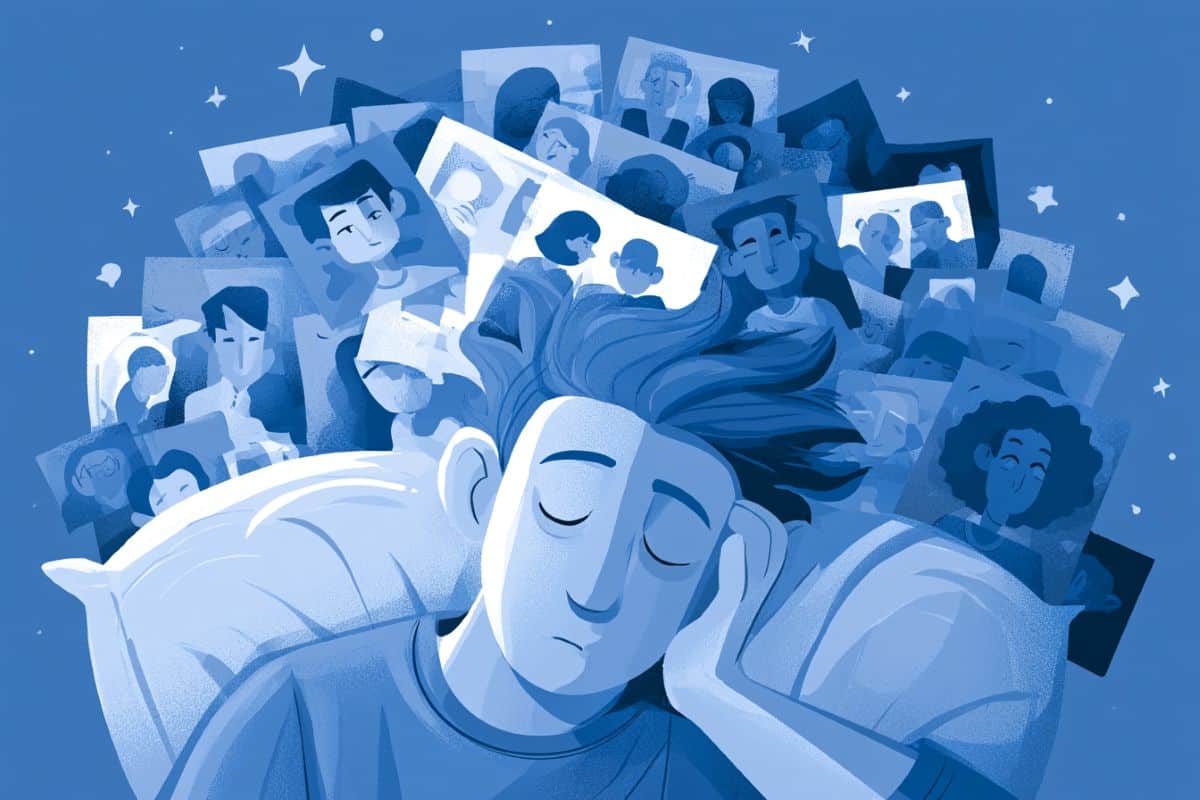
Summary: Memory loss induced by acute sleep deprivation is driven by a failure to access stored information rather than the permanent erasure of physical memory traces. The investigation tracked how sleep loss impairs a mammal’s capacity to differentiate between distinct social encounters experienced within the same environment.
The research team utilized high-precision optogenetics and structural pharmacology to show that sleep-deprived mice fail to recognize known peers. Strikingly, the team successfully restored these lost social memories by administering the clinically approved asthma medication roflumilast or by using targeted laser light to manually fire the hidden cell networks (engrams) holding the experience.
Key Facts
- Retrieval Failure vs. Storage Loss: For decades, the “brain fog” and amnesia following a night of poor sleep were assumed to stem from a failure to consolidate or physically lock down memories during rest. This study completely upends that model, proving that the brain successfully records and stores social experiences during sleep debt, but temporarily loses the operational keys required to retrieve them.
- The Shared Environment Multi-Individual Test: In everyday life, social interactions do not occur in a vacuum; individuals regularly encounter multiple distinct peers within the exact same room or office. To replicate this, researchers exposed mice to several different mice in a fixed environment. While well-rested mice effortlessly distinguished between them, sleep-deprived mice suffered total recognition failure, confusing familiar peers with total strangers.
- Pharmacological Rescue via Roflumilast: To bypass this sleep-induced block, the team administered roflumilast, a phosphodiesterase-4 (PDE4) enzyme inhibitor clinically approved to treat severe asthma and COPD, immediately prior to the re-encounter. The drug successfully restored full access to the hidden social memories, matching the team’s past data on spatial maze memories.
- Optogenetic Engram Reactivation: To provide definitive, indisputable proof that the social memories were completely intact inside the brain, neuroscientists deployed optogenetics. By tagging the specific ensemble of hippocampal neurons that fired during the initial social introduction, they later shone a laser light to manually reactivate those exact cells. The light blast instantly restored the mouse’s social recognition.
- Persistent Recovery Across Days: Remarkably, once the hidden memory engram was artificially reactivated via light, the mouse retained natural, un-aided access to that social memory for several days afterward, proving that a single targeted retrieval event can permanently repair sleep-induced amnesia tracks.
- The Shared Hippocampal Substrate: The study unmasks that both spatial layout mapping and multi-individual social indexing rely heavily on overlapping neural real estate within the hippocampus. Sleep deprivation targets this exact junction, making it highly difficult for the brain to keep closely related contextual experiences neatly separated.
- Translational Hope for Shift Workers and Dementia: By mapping the exact molecular gatekeeper that sleep debt disrupts, this research opens up therapeutic targets to persistently restore memory recall. This holds massive public health implications for retrograde amnesia, Alzheimer’s disease, and populations managing chronic sleep fragmentation, such as night-shift workers, medical personnel, students, and parents of newborns.
Source: University of Groningen
Anyone who has had a bad night knows that they can feel ‘foggy’ the next day. This fogginess may extend to our memory: remembering where we went, who we met, or what happened during the encounter.
Neuroscientist Robbert Havekes from the University of Groningen studies memory loss due to sleep deprivation.
In a study published in the journal Science Advances on 10 June, Havekes and lab member and first author Adithya Sarma show that sleep deprivation makes mice forget social encounters. However, they found that the social memories are not gone, the mice just can’t seem to recall them.
Havekes and his team studied mice who had social encounters with several other mice, each time in the same environment. Under normal circumstances, they would recognize the other mice when encountering them again. However, when they were sleep deprived after the first encounter, they did not recognize the mice at a later moment. But when they were given the clinically approved asthma drug roflumilast before that second encounter, they did recognize their fellow mice.
This suggests that the drug gives them access to those memories that were otherwise not accessible. In previous work, Havekes has found the same effect for spatial memories: sleep deprivation made the mice forget spatial information about a maze they had visited and roflumilast restored access to those memories.
Keeping experiences separate
The team found further evidence using optogenetics, a technique that allows specific groups of brain cells (memory engrams) to be activated with light. By reactivating brain cells involved in the original social experience, they were able to restore access to social memories disrupted by sleep deprivation. The restored access persisted for several days, suggesting that the memories themselves had remained stored in the brain.
‘We knew that spatial memory was vulnerable to sleep deprivation, with the hippocampus, a part of the brain that’s responsible for your memory and learning, playing a major role,’ explains Havekes.
‘What we didn’t know is that sleep deprivation also severely impairs the retrieval of memories of social interactions involving the same brain region. There is a logic to this, says Sarma: ‘In everyday life, social memories rarely occur in isolation. We often meet multiple individuals in the same place and must keep those experiences separate.’ Havekes: ‘We saw that sleep deprivation affects both types of memories through a similar process, which can be countered by roflumilast.’
Shift workers
The next challenge is to determine the exact mechanism underlying this process.
Havekes: ‘If we can understand the underlying mechanism, we may develop novel ways to truly and persistently restore the recall of individual social experiences, but also target other forms of amnesia.’
This might have implications for forms of retrograde amnesia, such as in Alzheimer’s disease, but also for people who regularly lose sleep, such as shift workers, healthcare workers, students, or parents of young children.
Key Questions Answered:
A: No, your experiences are not erased. This groundbreaking study from the University of Groningen demonstrates that sleep deprivation doesn’t stop your brain from storing memories; instead, it blocks your ability to access them. The physical memory trace remains completely intact inside your hippocampus, but your brain temporarily loses the retrieval mechanism needed to find and read that data the next day.
A: By opening a chemical back door in the brain. Roflumilast works by blocking an enzyme called PDE4, which normally breaks down a crucial cellular messenger molecule involved in memory formation and retrieval. By keeping this messenger molecule active, roflumilast boosts signaling inside sleep-deprived hippocampal cells, successfully bypassing the block caused by exhaustion and restoring immediate access to hidden memories.
A: Optogenetics is an advanced technique where scientists use harmless light to control specific, genetically modified brain cells. In this trial, researchers used a laser to manually flash the exact group of cells, called an engram, that formed when the mouse first met a peer. Because the flash of light instantly made the sleep-deprived mouse remember its friend, it provided definitive proof that the memory was never destroyed; it was simply waiting for the right key to unlock it.
Editorial Notes:
- This article was edited by a Neuroscience News editor.
- Journal paper reviewed in full.
- Additional context added by our staff.
About this sleep and memory research news
Author: Rene Fransen
Source: University of Groningen
Contact: Rene Fransen – University of Groningen
Image: The image is credited to Neuroscience News
Original Research: Open access.
“Restoring access to long-term social recognition memories disrupted by sleep deprivation” by Adithya Sarma, Camilla Paraciani, Junfei Cao, Evgeniya Tyumeneva, Caterina Stacchiola, Elroy L. Meijer, Nienke de Vries, Soraya Smit, Fleur Meijer, Marit Bonne, Jean-Christophe Billeter, Peter Meerlo, and Robbert Havekes. Science Advances
DOI:10.1126/sciadv.adu9805
Abstract
Restoring access to long-term social recognition memories disrupted by sleep deprivation
Long-term social memories are vital for forming and maintaining relationships, and social amnesia can disrupt daily life. Using a new paradigm to study these hippocampus-dependent memories, we show that mice can distinguish between multiple social experiences even when they occur in the same context across days.
Sleep deprivation immediately after socialization disrupts memory consolidation, leading to social amnesia. Treatment with the Food and Drug Administration–approved phosphodiesterase type 4 inhibitor roflumilast during sleep deprivation protects memory consolidation, while administration immediately before testing reverses social amnesia temporarily.
Optogenetic reactivation of dentate gyrus engram cells restores social memory access and enables selective retrieval of individual memories. In addition, using two cFos-based engram-tagging strategies, we find that sleep deprivation selectively affects reactivation of experience-specific engrams while not affecting engram formation or overlap.
These results suggest that impaired engram reactivation contributes to sleep deprivation–induced social amnesia and highlights the role of the hippocampal dentate gyrus in maintaining and distinguishing social experiences in a single context.