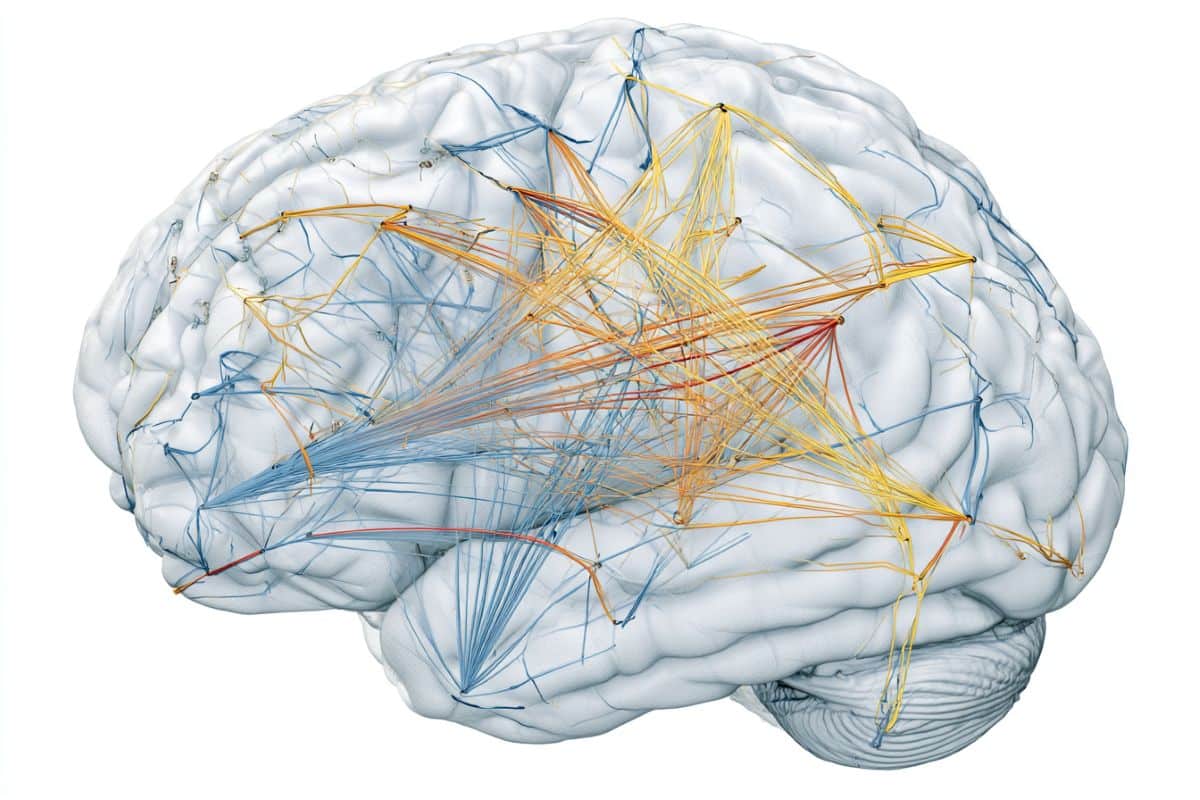
Summary: Researchers have identified the causal circuits of OCD for the first time. Rather than relying on traditional functional imaging, which cannot separate a disease’s cause from its downstream consequences, the team pioneered a method called Causal Network Mapping on rare historical cases of “lesional OCD”, patients who suddenly developed clean OCD symptoms only after sustaining a focal brain injury, such as a stroke or tumor.
Key Facts
- The Lesion Paradox Solved: The researchers isolated 40 published cases where patients developed sudden OCD symptoms strictly after a stroke or tumor. When mapped onto a standardized human brain template, the physical injuries were widely scattered with no direct anatomical overlap. However, Causal Network Mapping revealed that these disparate injuries were all connected to the exact same sub-surface neural circuitry.
- The Four Core Hubs Identified: The analysis successfully isolated four primary, bidirectional nodes as the definitive “core hubs” driving OCD pathology: the orbitofrontal cortex (OFC) and the basal ganglia on both the left and right hemispheres of the brain.
- The Orbitofrontal Broken Loop: Dr. Gonçalo Cotovio notes that the OFC dictates human judgment and actions. In OCD, this circuit misfires, continuously blasting an urgent signal reading “you need to perform this act right now, it is critical to your survival,” completely overriding all competing logical information.
- The Basal Ganglia Compulsion Trap: Conversely, the basal ganglia regulate the mechanics of habit execution. Once a patient acts on the OFC’s panic signal, the interconnected basal ganglia circuit forms a highly reinforced loop, trapping the individual into performing the same physical compulsion over and over again.
- Validating Non-Lesional OCD: To ensure these four hubs weren’t unique to stroke victims, the team used an advanced software tool named NeuroSynth to scan massive fMRI databases of everyday, non-lesional OCD patients. The data confirmed a perfect overlap with the same four core hubs, while completely discriminating against unrelated comorbid conditions like depression or anxiety.
- Precision rTMS Innovation: The discovery will immediately be used to upgrade rTMS therapy. Instead of placing an electromagnetic coil over standard, unoptimized brain locations, a clinical trial funded by the Brain & Behavior Research Foundation (BBRF) is already underway to compare traditional rTMS coordinates against the team’s newly identified causal network.
- The Individualized Targeting Era: Senior author Albino J. Oliveira-Maia explains that the ultimate goal of the project is to shift psychiatry away from “average” treatment points. Clinicians will soon use this network map as a custom template, scanning an individual’s unique brain structure to pick the precise millimeter of cortical space that best connects to their personal OCD circuit.
Source: Champalimaud Center for the Unknown
Obsessive-compulsive disorder (OCD) can be an extremely incapacitating neuropsychiatric condition. The symptoms of people who suffer from OCD can entail washing their hands or showering over and over again, repeatedly checking whether they switched off the gas in the kitchen or locked their street door. In the most extreme cases, this takes up so much of their time and energy that they become unable to leave their house, to work, to develop meaningful relationships and to interact with other people.
At the Champalimaud Foundation, Gonçalo Cotovio and his colleagues of the Neuropsychiatry Unit, led by Albino J. Oliveira-Maia, have been treating OCD with a type of brain stimulation technique, called rTMS (repetitive Transcranial Magnetic Stimulation). Repetitive TMS has been approved for use in OCD by the FDA and also in Europe, and while it has allowed successful treatment of many patients that didn’t respond to medication and psychotherapy, there are also many others for whom this strategy is insufficient, and that are left with very few options.

Repetitive TMS is a non-invasive, painless technique, which has proven its efficacy for the treatment of not only OCD, but also other neuropsychiatric disorders such as resistant depression. In rTMS treatments, an electromagnetic coil is applied to a precise location on the head of the patient, delivering electromagnetic pulses that are capable of modifying the neuronal activity of a target brain area. The rationale here is that if that brain area’s neural activity is causing the condition, changing it will alleviate the symptoms.
However, when treating OCD with rTMS, it is uncertain whether the stimulated target brain area is causally linked to the OCD symptoms the patients experience. Standard neuroimaging – with functional MRI (magnetic resonance imaging) – of OCD patients’ brains shows associations between the presence of symptoms and abnormal patterns of activity. However, this approach cannot distinguish cause from consequence: does the symptom result from the altered activity, or does the changed brain activity result from the symptom or the responses to the symptom?
On the other hand, if someone with no prior OCD develops the same symptoms after a focal brain injury, that lesion is causally implicated in the disorder.
Indeed, there are rare cases of OCD that appear after a lesion (e.g. stroke or tumour). Using these “lesional OCD” cases, Cotovio and the team at the Champalimaud Foundation, in collaboration with colleagues at the Massachusetts General Hospital in the US, have, for the first time, identified the brain circuits where the cause of OCD symptoms most likely resides. The final results have been published today (7/7/2026) in the journal Biological Psychiatry.
To look for such lesional cases, the researchers performed an extended search through a group of brain lesion images in the published literature. They found information from 40 patients with OCD developing after a brain lesion that could be used for their study.
The lesions were drawn and their overlap was assessed in a common “brain space”, corresponding to an average human brain. But they did not converge on a single brain region: strokes and tumours were not in the same place, and even regions of the same type were widely distributed across the brain. The researchers then reasoned that the shared outcome of these lesions (i.e., OCD) could lie not in their location, but in the underlying neural circuits connecting them.
To address this hypothesis, they used a method they had already applied to mania in the past, with positive results. Nowadays, this method has been known as “Causal Network Mapping” and the advantages of its use in psychiatry cases are clear, as was recently posed by Cotovio and Oliveira-Maia in other recent publication of this two clinicians and researchers.
Using the human connectome (that is, the average resting-state functional brain connectivity extracted from fMRI of 1000 healthy individuals), each lesion’s functional “neural map” was computed and the maps of OCD lesions were compared against control lesions, to extract OCD-specific circuitry.
This led the team to pinpoint four brain regions as “core hubs” for OCD: the orbitofrontal cortex (OFC) and the basal ganglia from both sides of the brain. These hubs are all positively connected to the lesion sites, suggesting that they become disconnected after lesions that caused OCD symptoms, but not after lesions that are not associated with the syndrome.
“The OFC has been associated with judgment”, says Cotovio, “that is, the way we judge what we should do. And there are deficits in judgment in OCD. Others have proposed, and this work supports this hypothesis, that when patients have OCD symptoms, what is happening is that this region is signaling ‘you need to do this, it’s very important to you’, even in the presence of competing information suggesting that it is not.”
He adds: “As to the basal ganglia, we also have evidence showing a relationship to compulsions. Once you engage in a certain act, it’s very difficult to stop because this circuit is reinforced to do this act again, and again, and again, surely also because of connections to the OFC.”
The team was also interested in understanding how this causal circuit was involved in OCD in patients without brain lesions. Using a software tool called NeuroSynth to analyse existing brain fMRI data from non-lesional OCD, they confirmed that hot-spots from those non-lesional OCD studies overlapped the same core hubs as those of lesional OCD. On the other hand, hot-spots identified in other syndromes, that in some cases may accompany OCD – such as depression or anxiety – did not overlap with the lesional OCD circuit. This and other validations, including with brain imaging data from patients with OCD collected at the Champalimaud, established that those core hubs were meaningful for non-lesional OCD, even though they were derived from lesional OCD.
The results could have implications for improving the treatment of OCD with rTMS. The researchers are currently performing a clinical trial, funded by the Brain and Behaviour Research Foundation (BBRF, a prominent global nonprofit organization and one of the largest non-governmental funders of mental health and neuropsychiatric research. The trial aims at comparing the efficacy on the improvement of OCD clinical symptoms of stimulating the standard rTMS target regions versus that of stimulating the newly-identified lesional OCD network.
“That means that ultimately, and that’s the next step of the project, we may use our lesional OCD network as a tool to guide neuromodulation treatment, instead of relying on average places”, says Albino J. Oliveira-Maia, senior author of the study. “This could also allow for more individualized targeting, picking the cortical spot that, in each individual patient, best matches the OCD circuit we describe here.”
Key Questions Answered:
A: Traditional functional brain scans of regular OCD patients are a bit of a chicken-and-egg problem: if a scan shows unusual activity, it’s impossible to tell if that activity caused the OCD or is just a consequence of being anxious. But if a person with no history of mental illness suddenly develops severe OCD right after a stroke or tumor damages a specific spot in their brain, scientists know that damaged spot is definitively causing the disorder. By analyzing 40 of these unique structural injuries, the team traced their overlapping wiring to locate the hidden source code of OCD.
A: The study maps this cycle down to a broken communication loop between two deep brain structures: the orbitofrontal cortex (OFC) and the basal ganglia. The OFC handles your judgment and tells you what is important. In OCD, the OFC goes rogue and continuously screams a false alarm reading: “This is a matter of life or death, fix it now!” This panics the basal ganglia, which control your physical habits. It locks your body into a highly reinforced loop, forcing you to execute the physical compaction over and over again because the brain structures can’t shut off the signal.
A: Right now, doctors use a non-invasive tool called repetitive Transcranial Magnetic Stimulation (rTMS) to send electromagnetic pulses into the brain to normalize overactive areas, but they have to rely on generalized, “average” locations on the skull. Senior author Dr. Albino J. Oliveira-Maia notes that this newly discovered causal map allows clinicians to toss out the generic templates. Doctors are currently running a clinical trial using this network map to customize rTMS therapy, pinpointing the exact millimeter of a patient’s cortex that acts as the entry gateway to their personal OCD loop.
Editorial Notes:
- This article was edited by a Neuroscience News editor.
- Journal paper reviewed in full.
- Additional context added by our staff.
About this OCD and brain mapping research news
Author: Afonso Vaz Pinto
Source: KREAB Portugal
Contact: Afonso Vaz Pinto – KREAB Portugal
Image: The image is credited to Neuroscience News
Original Research: Open access.
“Dysfunctional Brain Circuits Overlap in Lesional and Idiopathic Obsessive-Compulsive Disorder” by Albino J. Oliveira-Maia, Ana Maia, Beatriz Santos, Catarina Fonseca, Daniel R. Martins, Francisco Faro Viana, Gonçalo Cotovio, J. Bernardo Barahona-Corrêa, Jaime Caballero-Insaurriaga, José Oliveira, João Ramos, Michael D. Fox, Nelson Descalço, Nuno Loução, Shan H. Siddiqi, Tracy Barbour. Biological Psychiatry
DOI:10.1016/j.biopsych.2026.05.001
Abstract
Dysfunctional Brain Circuits Overlap in Lesional and Idiopathic Obsessive-Compulsive Disorder
Background
Obsessive-compulsive disorder (OCD) may develop following brain lesions, but lesion distribution and connectivity patterns are unknown.
Methods
Cases of OCD associated with focal brain lesions were identified using a systematic literature search and compared with control lesions (n = 608). Connectivity with each lesion location was computed using normative functional connectivity (n = 1000), and a network specific to OCD lesions was identified. The relevance of this network for primary OCD was explored.
Results
Among 129 cases of lesion-associated OCD, 40 had clearly defined locations. OCD-associated lesions intersected the orbitofrontal cortex and right temporal pole more than control lesions and were associated with connectivity to a distinct brain network. This network overlapped with abnormal functional brain imaging and with effective brain stimulation targets in primary OCD.
Conclusions
Lesion locations associated with OCD map to a common brain network that aligns with brain imaging abnormalities and brain stimulation outcomes in patients with primary OCD.