Summary: For more than half a century, the medical fields of artificial vision and artificial touch have evolved along entirely separate tracks. Neuroscientists working to restore sight to the blind have operated in isolated ophthalmology spaces, while roboticists engineering bionic touch for paralyzed individuals have clustered in distinct motor-rehabilitation clinics. Because these researchers attended different global conferences and treated entirely separate patient groups, the underlying technological frameworks for both disciplines were assumed to be fundamentally distinct.
In a new study, researchers shattered this 50-year-old clinical wall. Researchers discovered that the advanced Brain-Computer Interface (BCI) architectures used for both touch and vision prostheses are, in fact, almost identical. By comparing visual cortical prostheses (VCP) and somatosensory cortical prostheses (SCP) side by side for the first time, the study reveals that both senses rely on the exact same neural, computational, and electrical stimulation principles.
This consolidation of data means that a breakthrough in one field instantly accelerates the other, promising to shave years off the development timeline for bringing viable sense-restoration technologies to millions of patients suffering from untreatable sight loss and paralysis.
Key Facts
- The Shared Blueprint Discovery: Despite 50 years of parallel, completely isolated development, the hardware algorithms, electrode configurations, and cortical microstimulation patterns used to generate artificial sight and artificial touch are functionally identical.
- How Cortical BCIs Operate: Both systems bypass damaged biological pathways (such as a destroyed optic nerve or a severed spinal cord). By implanting microelectrodes directly into the cerebral cortex, they intercept external digital data (from a camera or a robotic hand) and inject electrical micro-pulses directly into the brain, mimicking natural organic sensations.
- The Complexity Convergence: The inspiration for the unified theory arose when researchers trying to restore advanced tactile sensations (like feeling the sharp edge of an object or mapping texture motion) realized that artificial vision researchers were using the exact same mathematical formulas to generate complex visual patterns (phosphenes).
- The Biological Logic: The technological overlap exists because natural vision and natural touch share common neural and computational principles in the human body. Both systems function by taking complex physical inputs from the outside world (light hitting the retina or pressure compressing the skin) and converting them into electrical frequencies for the brain to decode.
- Dismantling Clinical Silos: Historically, the separation of these fields hindered therapeutic progress. Merging them into a single, cohesive discipline creates a massive cross-pollination pipeline where clinical trial data from vision implants can directly optimize bionic limb control.
- The Future Department of Sense Restoration: The authors propose a complete restructuring of hospital architecture, envisioning a future where patients with distinct neural deficits visit a unified “Department of Sense Restoration” to access a singular, streamlined BCI platform.
Source: Chalmers University of Technology
Patients with untreatable conditions such as sight loss or loss of motor-function could be closer to a viable technology for restoring their lost sense, within a faster time frame. This is due to the discovery that advanced brain interfacing technology used for both touch and vision prostheses, is in fact almost the same, despite being developed completely separately for more than 50 years.
The comprehensive review in which this discovery has first been made, was published in Nature Reviews Bioengineering, and was led by Giacomo Valle, Assistant Professor at Chalmers University of Technology, in Sweden.

Despite being developed separately, brain-computer interfaces or BCIs are an emerging field of technology that are being used for restoring more than one lost sense in the body, with visual cortical prostheses (VCP) for vision, and somatosensory cortical prostheses (SCP) for touch.
BCIs work by implanting a microelectrode directly into the brain, to enable direct communication between the brain and external devices (such as a camera or a bionic hand). They can bypass the damaged pathways in the body by directly stimulating a specific region of the brain and mimicking a natural sensation in a patient.
“This technology presents a real step forward for patients with otherwise untreatable conditions, in both the fields of sight-loss and loss of motor-function (such as paralysis), giving the ability to control movements, communicate or regain tactile sensation or vision, which previously was not possible”, says Giacomo Valle.
One technology, two separate senses
Natural vision and touch have common neural and computational principles in the body; whereby complex information is gathered from the outside world (via the eye or the skin/ hand) and converted into an electrical signal for the brain. Both fields of research have therefore been able to use similar technology to replicate these sensations artificially, with the BCIs placed in different regions of the brain. Yet neither field has spoken to each other until now.
“Normally people work on artificial touch or artificial vision. Researchers go to different conferences and deal with very different conditions and different patients, in different areas of the hospital. There has been parallel development for both senses, but we never talked about this on a global level. Until now, we hadn’t seen this as a common challenge”, says Valle.
The inspiration behind the review
The review paper ‘Restoring vision and touch with cortical microstimulation’ compares visual and sensory prostheses side by side for the first time and discusses how the two fields of research can learn from each other. It looks into how electrical stimulation of the cerebral cortex works, the types of electrodes used, how artificial visual and tactile experiences are created, the results of clinical trials to date and what technical and clinical barriers remain.
“The idea of merging the two fields of research came from the last paper that I worked on. We were going beyond restoring a simple sense of touch, moving to more complex sensations. We had to consider how to restore the sense of an edge or tactile motion. And through research, I found that the field of artificial vision was looking at the same challenge, aiming for a more complex artificial vision,” says Valle.
He points out that in the past, sight-loss and paralysis have been two very different fields of research, with unique challenges and different approaches to solving how to restore these in the body. But with the ongoing and rapid development of technology, these two fields have reached a coalescence.
“Hopefully our paper opens doors for a beneficial collaboration between the two fields and brings us closer to one technology for both artificial vision and touch that would benefit both patient groups. I have a dream for the future that there is one department in the hospital where a patient can go for ‘sense restoration’ and our unified technology would be easily accessible for all,” says Valle.
Key Questions Answered:
A: At their biological core, your brain cells don’t actually “see” light or “feel” physical pressure—they only speak a single language: electricity. When you look at an object or touch a tabletop, your eyes and skin simply act as translation devices, turning those physical events into electrical signals that travel up nerves to the brain. Because both senses operate on identical computational rules, a Brain-Computer Interface can use the exact same microelectrode hardware to inject those signals artificially. The only difference is where you plug it in; put the array in the back of the brain (occipital lobe) and the patient experiences flashes of sight; put it in the top of the brain (parietal lobe) and they feel touch.
A: This is a classic case of scientific isolation, or “siloing.” If you were a scientist working on artificial sight, you worked in eye clinics, treated blind patients, and went to ophthalmology conferences. If you worked on bionic hands, you worked with amputees and went to robotics and engineering conferences. Because the medical conditions, patients, and hospital wings were completely separate, researchers never looked over the fence to see what their peers were doing. Dr. Giacomo Valle’s review paper marks the first time anyone has forced these two disciplines to sit down side-by-side to compare their notes and clinical trials globally.
A: It acts as a massive evolutionary accelerator. Previously, each field had to solve its own technical and clinical bottlenecks completely on its own. Now that we know the core math and hardware are identical, any major breakthrough made in artificial vision immediately updates and repairs a flaw in artificial touch, and vice versa. If a vision lab discovers a safer way to layout microelectrodes to prevent brain tissue scarring, a bionic limb lab can copy that exact architecture the next day. This unified front dramatically cuts down research duplication, pools funding resources, and fast-tracks regulatory clinical approval for both paralyzed and blind individuals.
Editorial Notes:
- This article was edited by a Neuroscience News editor.
- Journal paper reviewed in full.
- Additional context added by our staff.
About this neurotech research news
Author: Emma Fry
Source: Chalmers University of Technology
Contact: Emma Fry – Chalmers University of Technology
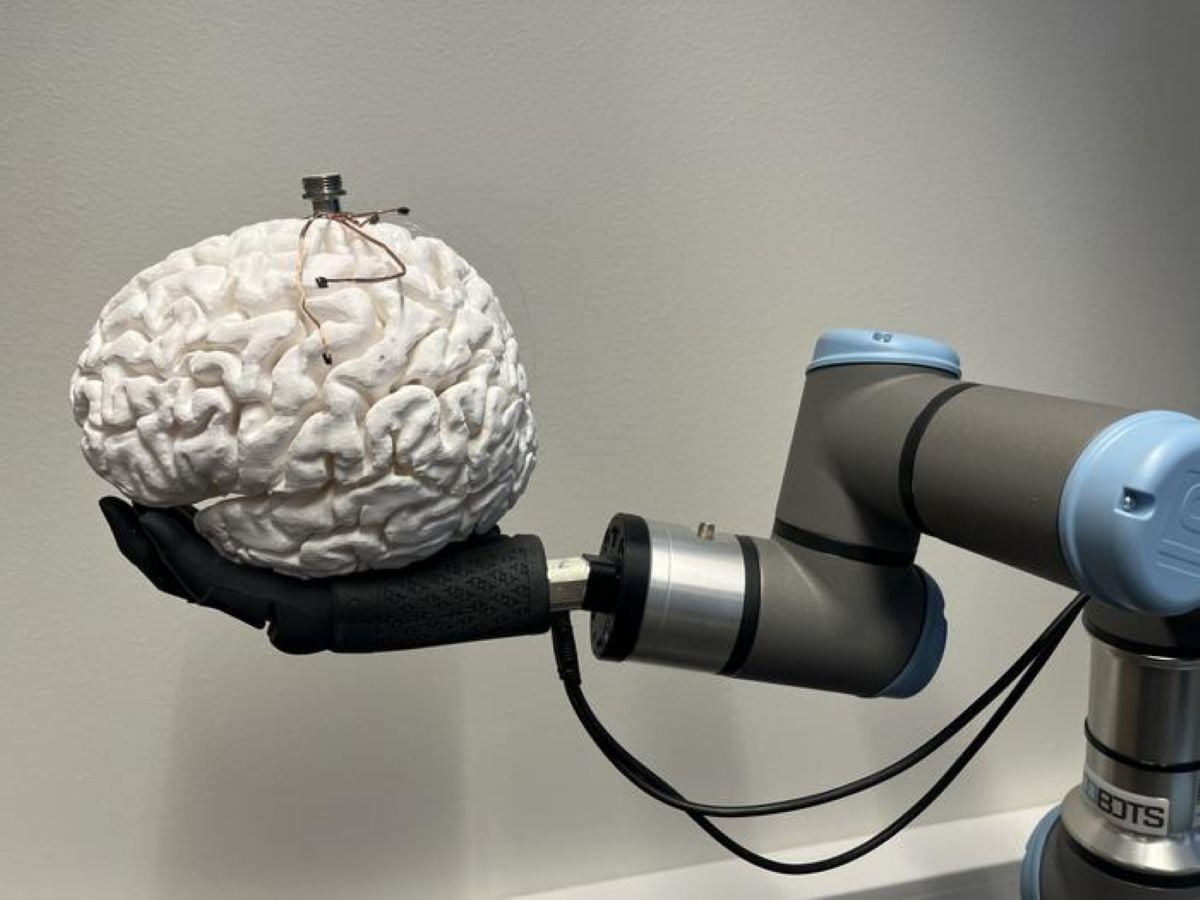
Image: The image is credited to Chalmers University of Technology – Giacomo Valle
Original Research: Open access.
“Restoring vision and touch with cortical microstimulation” by Giacomo Valle, Denise Oswalt, Robert A. Gaunt, Pieter Roelfsema, Charles M. Greenspon & Eduardo Fernandez. Nature Reviews Bioengineering
DOI:10.1038/s44222-026-00449-z
Abstract
Restoring vision and touch with cortical microstimulation
The restoration of sensory function following injury or disease represents a critical challenge in neuroengineering. Sensory neuroprostheses, particularly those targeting the primary visual (V1) and somatosensory (S1) cortices, promise to bypass damaged afferent pathways and reintroduce sensory percepts through direct cortical stimulation.
Building on foundational insights from non-human primate research, epicortical and intracortical microstimulation has been used to evoke artificial visual and tactile experiences in early human trials.
In this Review, we examine the state of cortical sensory prostheses, focusing on visual and somatosensory applications.
We compare neural encoding strategies for touch and vision, discuss the technical and clinical requirements of cortical stimulation, and evaluate the qualitative advantages of these devices over conventional assistive technologies. We also highlight emerging directions, including biomimetic encoding, multisensory integration and alternative implant sites, that could enhance the fidelity and usability of future interfaces.
Together, these developments mark a critical step towards clinically viable, high-resolution restoration of naturalistic sensation.