Summary: Kinesthesia, the sense of muscle movement and joint position—is the foundational feedback loop required for natural, intuitive motor control. When a patient undergoes a limb amputation, this vital sensory loop is severed, forcing users of standard prosthetic devices to rely entirely on visual tracking to guide their movements.
While bioengineers can use mechanical vibration to stimulate residual muscle fibers and recreate a phantom sense of motion, these vibrations typically bleed into the skin, sending conflicting tactical signals that overwhelm and confuse the brain’s sensory mapping.
To solve this sensory bottleneck, a milestone international collaboration has mapped the precise neurological architecture of artificial movement sensation. By merging data from the world’s only two distinct brain-machine interfaces designed to restore upper-limb kinesthesia, researchers discovered that the human brain does not process muscle feedback as an array of isolated data lines. Instead, the brain natively bundles incoming sensory data into pre-coordinated, subconscious movement patterns known as cortical synergies.
Key Facts
- The Cross-Platform Breakthrough: The study achieved rare clinical cross-validation by unifying data from two structurally opposite neural interfaces: Sant’Anna’s deep-muscle magnetic implant system and Cleveland Clinic’s surgical nerve-redirection (targeted reinnervation) platform.
- Discovery of Sensory Synergies: Despite using radically different surgical and robotic methods, both systems produced identical perceptual maps in patients, proving that the brain automatically reorganizes raw deep-muscle vibrations into holistic, multi-finger hand grasp trajectories.
- Subconscious Neural Processing: Both research teams documented that a significant portion of the kinesthetic feedback piped into the nervous system was successfully processed by the brain entirely beneath the user’s conscious awareness, mimicking natural biological proprioception.
- The Myokinetic Magnet Interface: Sant’Anna’s MKkI system utilizes micro-magnets implanted inside the patient’s residual forearm muscles. By vibrating these internal magnets, the system stimulates deep muscle spindles directly from the inside out, completely bypassing the skin surface.
- The Six-Week Patient Trial: A 34-year-old Italian amputee underwent a six-week trial with the temporary MKkI array, reporting exceptionally fluent, high-fidelity perceptions of hand opening and finger closing that closely mirrored natural physiological sensations.
- Roadmap to Permanent Bi-Directional Implants: Having proved the acute clinical utility of sensory synergies, the team is now developing a long-term, permanent implant. This next-generation device will simultaneously track magnetic positions to control robotic articulation while superimposing micro-vibrations to write lifelike sensory data back into the brain.
Source: Sant’Anna School of Advanced Studies, Pisa
A research team led by Sant’Anna School of Advanced Studies in Pisa in collaboration with Cleveland Clinic has uncovered new insight into how the brain senses movement. Their findings, published in Science Advances, could potentially help improve sensation and movement for prosthetic limbs.
By combining data from the world’s only two neural-machine interfaces designed to restore kinesthetic sensation – or the sense of movement – in upper limb prosthetics, the researchers found that the brain appears to process this information not as isolated signals, but as coordinated hand grasp movement patterns, or “synergies.”

Kinesthesia, the sense of muscle movement, is essential for natural motor control. It is lost after amputation, making prostheses harder to use intuitively. Muscle vibration can be used to generate perceptions of movement, but these vibrations typically stimulate both skin and muscle at the same time, which can confuse the brain while using prosthetics.
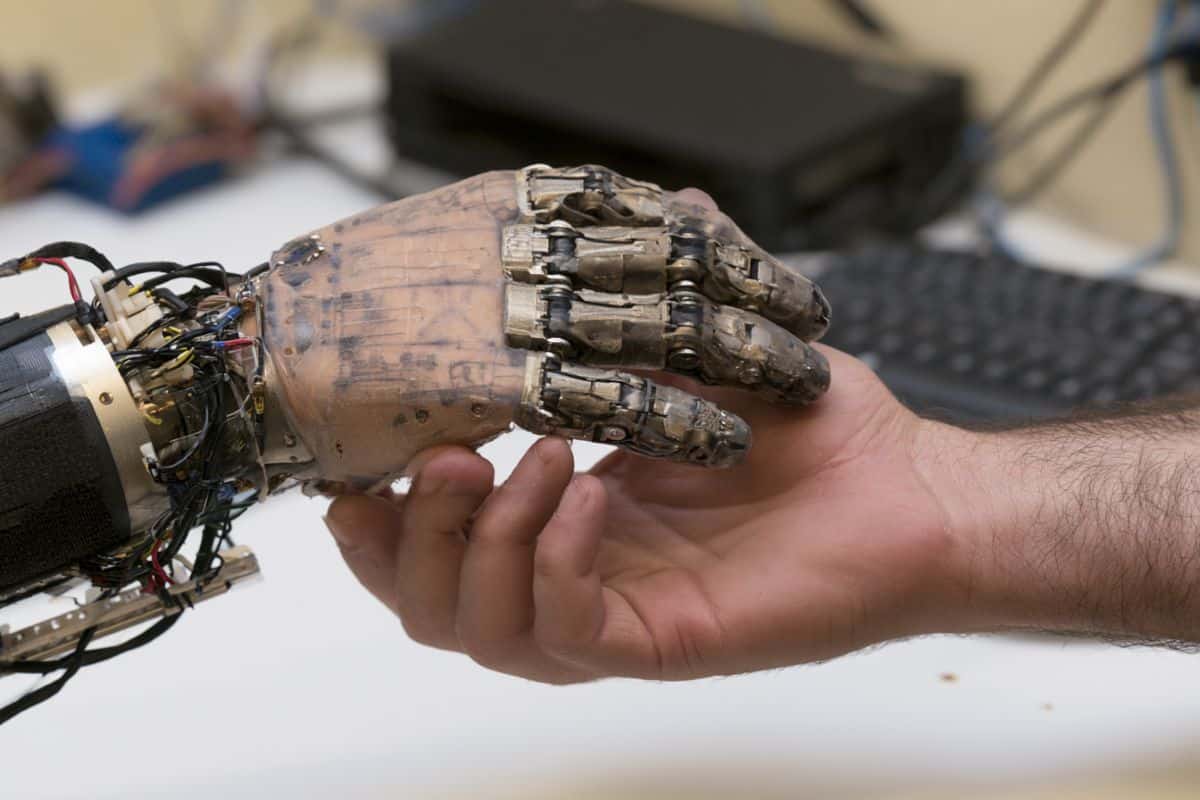
To address this, Sant’Anna developed the myokinetic kinesthetic interface (MKkI), a new bidirectional interface for hand prostheses that uses vibrations generated by small magnets implanted in the residual forearm muscles to restore natural sensations of movement. The system was integrated with the Mia Hand robotic hand developed by the Sant’Anna spin-off company Prensilia.
The team tested the interface between the hand and the brain for six weeks in a 34-year-old Italian patient, who perceived hand opening and closing with coordinated movements, very similar to real ones.
“The myokinetic kinesthetic interface is unique because it uses a simple, minimally invasive implant to stimulate muscles without touching the skin. This approach may be the key to better understanding how human motor control works, but also how to restore movement sensation after amputation,” says Federico Masiero, Ph.D., first author of the study, former Ph.D. student at Sant’Anna, and currently a postdoctoral researcher at the Munich Institute of Robotics and Machine Intelligence (MIRMI) of the Technical University of Munich (TUM).
The coordinated hand movements felt by the patient appeared similar to those felt by participants with a different kinesthetic feedback system built by researchers at Cleveland Clinic. The two prosthetic interface systems were structurally different. The one developed at Sant’Anna used implanted magnets and the other at Cleveland Clinic used surgical nerve redirection and robotics.
Even so, both kinesthetic interfaces, which function by specifically vibrating the deep muscles, produced similar perceptual results: induced movement sensations were perceived as coordinated finger movements rather than separate signals. Both research teams also observed that some sensations transmitted through their respective interfaces were perceived by the patient without their users being immediately aware of them.
Together, the teams’ findings suggest that the brain may organize movement sensation from the muscles in a more coordinated and more subconscious fashion than previously understood. This new result paves the way for more intuitive control of prostheses and may also have future applications in stroke rehabilitation, epilepsy and pain treatment.
“The ability to compare independently generated data from two very different interfaces makes these findings especially compelling,” says Professor Paul Marasco, Ph.D., coordinator of the study at Cleveland Clinic. “It gives us a stronger foundation for designing therapies and devices that work with the nervous system in a more natural way, with the ultimate goal of improving outcomes for patients.”
The research outlook: toward a permanent implant
The team’s next goal is to use prior work reading out the position of implanted magnets to control the prosthesis while simultaneously writing in to the magnets with superimposed vibration to restore natural sensory perceptions. The longer-term aim is to develop a permanent implant.
These current projects and the team’s earlier collaborative studies lay the groundwork for combining natural grasp sensation with intuitive motor control in people with hand loss, potentially elevating the function of an emerging generation of more human-like prosthetic devices.
“Our solution was implemented as a preliminary demonstrator: the implant was designed to last six weeks, a period we considered sufficient for an initial verification of the interface’s usefulness and effectiveness. The results were very promising and prompted us to explore a permanent implantable solution, which will allow us to study the interface over much longer periods and with a larger number of participants,” says Professor Christian Cipriani, the creator of the interface and coordinator of the study.
The research team behind the study
Funding: The study, coordinated by The BioRobotics Institute of the Sant’Anna School of Advanced Studies in Pisa, in collaboration with the Pisa University Hospital (AOUP) and Cleveland Clinic, was supported by European, Italian, and U.S. funding. These include the ERC projects MYKI and MYTI, the Fit For Medical Robotics and PROPRIOUSS projects funded by the Italian Ministry of University and Research, and US data originally collected under awards from the NIH Office of the Director and DARPA. The first author of the study is a researcher at the Technical University of Munich, funded by a Marie Skłodowska-Curie Action fellowship.
Key Questions Answered:
A: In traditional bionics, engineers assumed that to make a realistic prosthetic hand, they had to send individual, separate signals for every single mechanical finger, one wire for the index, one for the thumb, and so on. A “cortical synergy” is the brain’s elegant internal shorthand. The brain doesn’t think about moving fingers in isolation; it thinks in pre-packaged, coordinated groups, like a unified “fist close” or a “pinching grasp.” This study proved that when deep muscles are stimulated, the brain automatically clusters those raw sensations into these holistic synergies. Knowing this allows engineers to stop writing hyper-complex, finger-by-finger data code, and instead send broad, coordinated signal packages that the brain naturally understands.
A: The myokinetic kinesthetic interface (MKkI) uses small, sterile magnets slipped directly inside the residual muscle fibers of an amputee’s forearm. When the patient tries to move their missing hand, these muscles still flex and stretch, moving the magnets. External sensors on the prosthetic cuff read those magnetic movements to drive the motors of the robotic hand. To send sensation back to the patient, the prosthesis reverses this trick: it sends a customized magnetic frequency back through the cuff, causing the internal magnets to vibrate deep inside the muscle body. This directly triggers the deep muscle spindles, the biological motion sensors inside our flesh, allowing the patient to feel the prosthetic fingers closing without irritating any surface skin nerves.
A: In neuroscience, a single lab’s discovery can sometimes be a fluke or an artifact of their specific equipment. Here, the two teams used totally different methods: Sant’Anna used sub-dermal magnetic vibrations in Italy, while the Cleveland Clinic used surgical nerve redirection (splicing hand nerves into alternative muscle beds) in America. Despite these completely opposite structural approaches, when both teams vibrated the deep muscle tissue, their patients reported the exact same biological experience: smooth, subconscious, unified hand movements. This cross-laboratory validation proves that they have uncovered a fundamental, universal rule of human neurobiology, providing a bulletproof foundation for building permanent neural interfaces worldwide.
Editorial Notes:
- This article was edited by a Neuroscience News editor.
- Journal paper reviewed in full.
- Additional context added by our staff.
About this neurotech and robotics research news
Author: Michele Nardini
Source: Sant’Anna School of Advanced Studies, Pisa
Contact: Michele Nardini – Sant’Anna School of Advanced Studies, Pisa
Image: The image is credited to Neuroscience News
Original Research: Open access.
“Coordinated hand movement sensation revealed through an implanted magnetic prosthetic kinesthetic interface” by Federico Masiero, Mattia Gentile, Marta Gherardini, Eliana La Frazia, Charles H. Moore, B. Kilic, Valerio Ianniciello, Roberta Reho, Tommaso Mori, Flavia Paggetti, Lorenzo Andreani, Simon A. Whitton, Paul D. Marasco, Christian Cipriani. Science Advances
DOI:10.1126/sciadv.adx5046
Abstract
Coordinated hand movement sensation revealed through an implanted magnetic prosthetic kinesthetic interface
Muscle contractions to control prosthetic hands do not feel like those to control natural hands because amputation decouples movement sense (kinesthesia) from movement execution. The myokinetic kinesthetic interface (MKkI) uses remote vibration of permanent magnets implanted in amputated forearm muscles to restore kinesthesia.
A participant reported coordinated finger movements of hand closing and opening, constrained within physiological bounds, with stereotypical conformations and dynamics. Aggregated unstructured explorations and systematic psychophysics exposed unreported perceptual sensitivity at vibration frequencies that trigger kinesthetic sensations.
Complex coordinated grip sensations elicited from single forearm muscles reveal that kinesthetic brain representations are likely rooted in perception of synergistic movement production. By leveraging the natural synergistic features of kinesthesia, the MKkI will help link perception and action to functionally elevate emerging intuitive bidirectional human-machine interfaces.