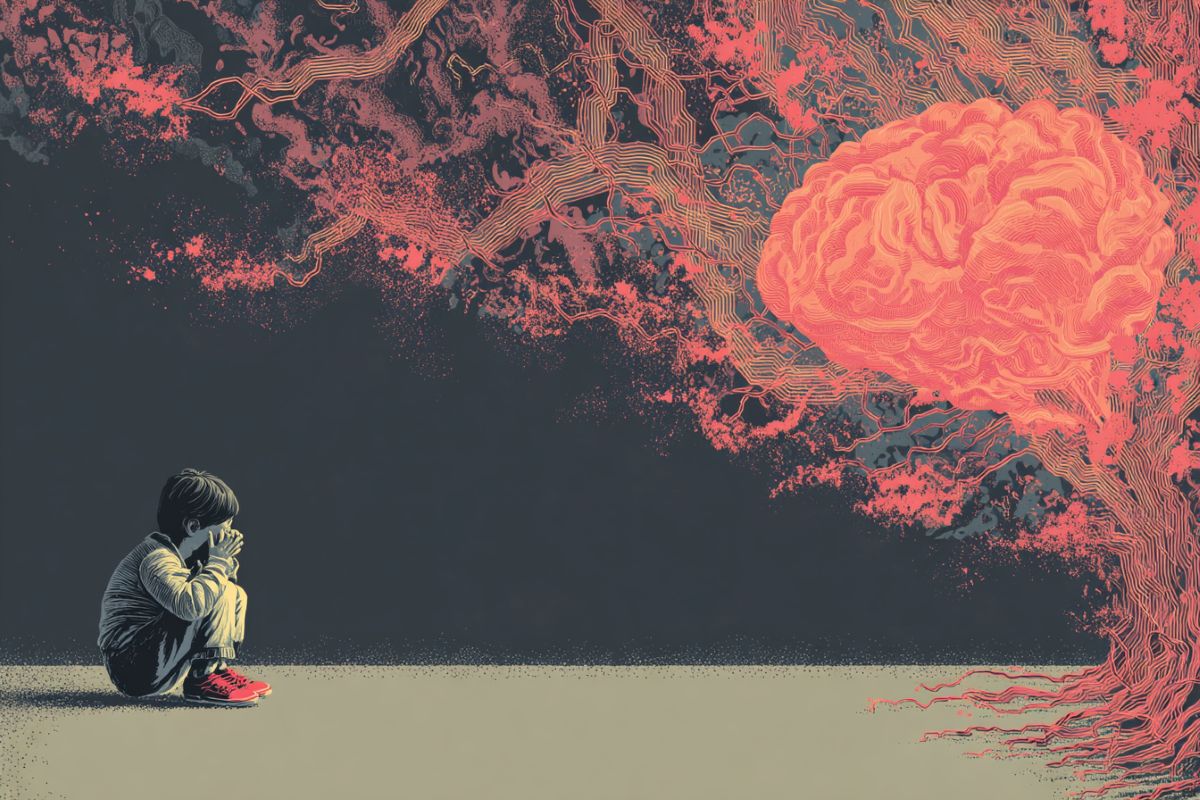
Summary: A new study revealed the precise biological pathways by which early-life adversity becomes “embodied,” translating childhood trauma into lifelong physical and psychological health vulnerabilities. The investigation utilized high-resolution functional magnetic resonance imaging (fMRI) paired with systemic inflammatory biomarker tracking in 128 young adults.
The research team mapped how specific types of maltreatment (abuse vs. neglect) occurring at critical developmental stages (early childhood vs. late adolescence) fundamentally rewrite the communication lines between the brain’s core fear circuitry, including the amygdala and ventromedial prefrontal cortex (vmPFC), and key inflammatory cytokines, specifically Interleukin-8 (IL-8) and Interleukin-17 (IL-17).
Key Facts
- The Embodiment of Adversity: While epidemiological data has long linked childhood trauma to adult psychological disorders and autoimmune conditions, this study provides the first direct evidence that maltreatment actively remodels the real-time communication loops connecting the immune system and the brain’s fear learning circuits.
- The 128-Subject Cohort Blueprint: Researchers tracked 128 young adults, capturing retrospective reports of childhood abuse and neglect. To isolate the impact of developmental timing, data was split into two strict operational windows: early childhood (ages 1–11) and late adolescence (ages 12–18).
- Early Abuse Modulates the Amygdala-IL-8 Axis: The fMRI scans captured during fear conditioning tasks demonstrated that severe abuse during early childhood (ages 1–11) selectively warps the relationship between amygdala activation, the brain’s primitive threat-detection center—and systemic levels of the inflammatory cytokine IL-8.
- Late Neglect Alters the Regulatory vmPFC-IL-8 Track: Conversely, emotional or physical neglect experienced during late adolescence (ages 12–18) selectively reshapes the link between the ventromedial prefrontal cortex (vmPFC), the slow-maturing region responsible for regulating emotion and extinguishing fear responses, and IL-8.
- Neglect Disrupts the IL-17 Neuro-Network Grid: Early childhood neglect was shown to deeply modify functional connectivity between the amygdala and the vmPFC, as well as between the memory-encoding hippocampus and the vmPFC, in direct correlation with systemic IL-17 levels.
- The Maturation Match Hypothesis: The findings unmask a profound biological rule: the timing of trauma matches the natural maturation schedule of the brain. Abuse hits threat-processing structures (like the amygdala) that develop early in life, whereas neglect disrupts higher-order executive and regulatory regions (like the vmPFC) that develop slowly across adolescence.
- Translational Dual-Target Therapies: By shifting the paradigm from an isolated neurological or psychiatric model to an integrated neuro-immune framework, this research provides an objective blueprint to design trauma-informed medical interventions that simultaneously treat both neural fear circuits and chronic systemic inflammation.
Source: KeAi Communications
Childhood maltreatment is known to exert long-lasting impacts on physical and mental health, yet the underlying biological pathways remain poorly understood.
A new study published in Brain Science and Child Development sheds light on how adverse experiences in early life become “embodied” by altering interactions between fear-related brain function and systemic inflammation.
The researchers of the study, from Guangzhou University, investigated how the type and timing of childhood maltreatment shape the link between brain activity during fear learning and two key inflammatory markers, interleukin-8 (IL-8) and interleukin-17 (IL-17).
“We included 128 young adults who completed retrospective reports of childhood abuse and neglect, divided into early (ages 1-11) and late (ages 12-18) periods,” shares corresponding author Jianjun Zhu. “Brain function was measured using functional magnetic resonance imaging (fMRI) during a fear conditioning task.”
The results showed that childhood maltreatment does not simply affect the brain or inflammation alone—it modulates how they connect.
“Early abuse significantly altered the relationship between amygdala activity and IL-8 levels, while late neglect shaped the link between ventromedial prefrontal cortex (vmPFC) activation and IL-8,” explains Zhu. “Early neglect also modified connectivity between the amygdala and vmPFC, as well as between the hippocampus and vmPFC, in relation to IL-17 levels.”
The team’s findings highlight a critical insight: the timing and type of childhood adversity matter greatly. Abuse during early childhood impacts threat-related brain regions that mature earlier, whereas neglect in later adolescence affects regulatory brain areas that develop more slowly.
According to the researchers, this study provides the first evidence that childhood maltreatment adjusts the communication between the brain’s fear circuitry and the immune system.
“By revealing how early adversity remodels neuro-immune interactions, our findings explain why people with a history of childhood trauma face higher risks of long-term physical and psychological health problems,” says Zhu.
Further, the results may support the development of more targeted interventions that address both neural and immune components of trauma-related disorders.
Key Questions Answered:
A: Through a process called biological embodiment. When a child experiences severe stress or neglect, their body releases continuous waves of stress chemicals that actively alter how immune cells develop. This Guangzhou University study proves that childhood trauma permanently remodels the biological communication lines between the brain’s fear circuits and systemic inflammation, meaning an adult’s immune system stays stuck in a hyper-reactive, inflammatory state due to childhood injuries.
A: Because the trauma disrupts whatever specific brain region is growing fastest at that age. In early childhood, primitive threat centers like the amygdala mature first, making them highly vulnerable to early abuse. In contrast, regulatory regions like the prefrontal cortex mature slowly and continue growing into adolescence, meaning late neglect targets and disrupts the brain’s ability to logically calm itself down.
A: It shifts treatment from a pure psychological model to a whole-body medical approach. Historically, trauma has been treated strictly as a mental health condition through talk therapy. By showing that childhood trauma is an integrated neuro-immune disorder that elevates pro-inflammatory markers like IL-8 and IL-17, this data allows medical teams to build dual-action therapies that target both brain fear patterns and chronic physical inflammation to restore long-term healthspan.
Editorial Notes:
- This article was edited by a Neuroscience News editor.
- Journal paper reviewed in full.
- Additional context added by our staff.
About this childhood trauma and neuroscience research news
Author: Ye He
Source: KeAi Communications
Contact: Ye He – KeAi Communications
Image: The image is credited to Neuroscience News
Original Research: Open access.
“Associations between brain function during fear learning and inflammatory levels: The moderating roles of early and late maltreatment” by Yuanyuan Chen, Rushan Liu, and Jianjun Zhu. Brain Science and Child Development
DOI:10.1016/j.bscd.2026.100001
Abstract
Associations between brain function during fear learning and inflammatory levels: The moderating roles of early and late maltreatment
Fear learning is a core adaptive process. Although growing evidence indicates that associations between inflammation and both brain structure and reward-related function can be moderated by early risk factors, it remains unclear whether childhood maltreatment moderates links between inflammation and brain function during fear learning.
We tested this question in young adults (n = 128; 72 female, 56 male; mean age = 21.31 years, SD = 2.52; range = 17–28). Childhood maltreatment was assessed retrospectively as abuse and neglect during early childhood (ages 0–11) and late childhood (ages 12–18). Inflammation was indexed by interleukin-8 (IL-8) and interleukin-17 (IL-17), log-transformed and standardized. Functional MRI measured brain activation and connectivity during fear learning.
Early abuse moderated the association between amygdala activation and IL-8 levels, and late neglect moderated the association between ventromedial prefrontal cortex (vmPFC) activation and IL-8 levels. Early neglect also significantly moderated the association between amygdala–vmPFC connectivity and IL-17 levels. To our knowledge, this is the first evidence that the type and timing of childhood maltreatment jointly shape brain–immune relationships during fear learning.
These findings advance understanding of how early adversity may confer risk for physical and mental health problems by altering interactions between neural circuits and inflammatory processes.