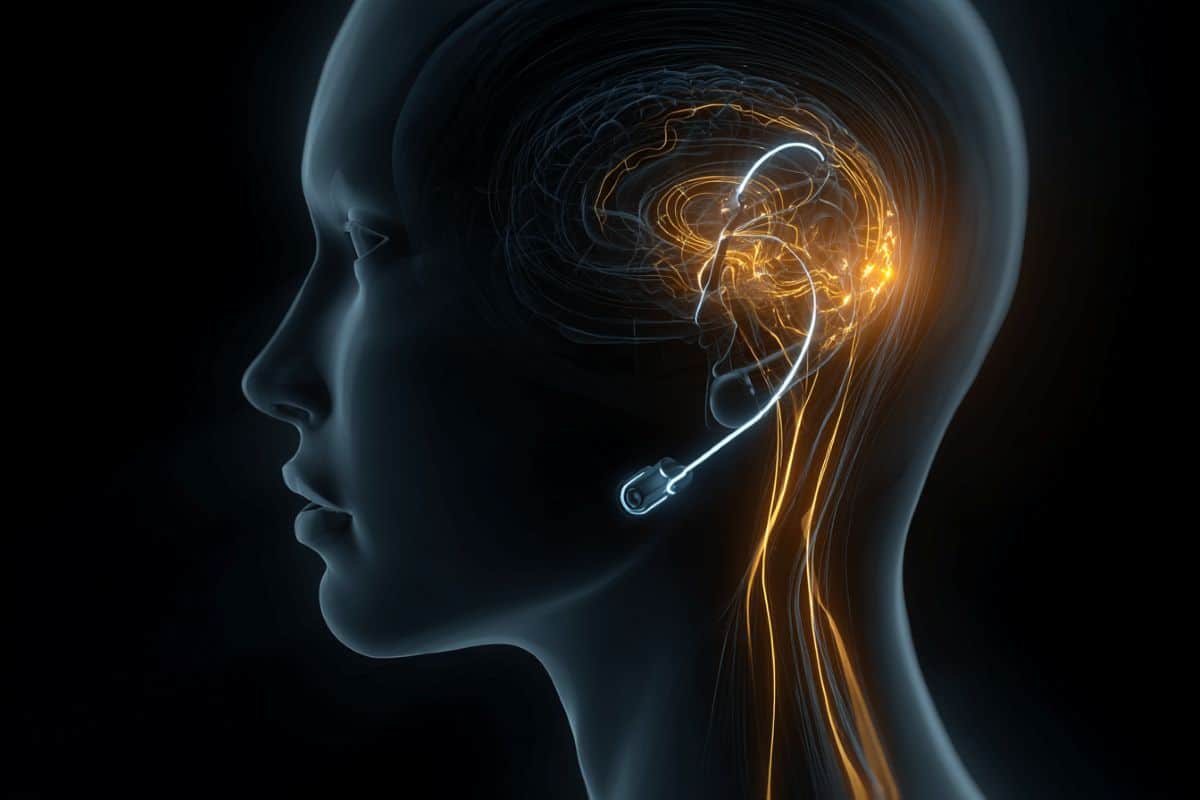
Summary: A precision neuroengineering study provided the first localized evidence of how noninvasive vagus nerve stimulation interacts with human motor pathways during active movement. The clinical trial investigates transcutaneous auricular vagus nerve stimulation (taVNS) as a supplemental intervention for physical therapy.
By pairing short bursts of electrical stimulation with voluntary finger movements, researchers demonstrated that taVNS does not produce broad, generic physiological changes, but instead isolates and drives highly specific motor cortex activity and autonomic arousal states, opening new avenues to optimize stroke and mobility rehabilitation protocols.
Key Facts
- The Vagal-Motor Blind Spot: The vagus nerve acts as the primary bidirectional superhighway connecting the brain to major visceral organs. While noninvasive ear-based stimulation (taVNS) is frequently used to assist patients with mobility issues, science has lacked an understanding of how these electrical bursts physically interact with active motor networks in real time.
- The Movement-Paired Trial: Investigators delivered targeted, brief bursts of taVNS to 36 healthy volunteers engaged in a computer-cued behavioral task requiring them to tap or withhold tapping their fingers at completely randomized intervals.
- Anatomical Specificity Proven: When compared to baseline trials with no electrical input, movement-paired taVNS caused an immediate, measurable increase in activity within movement-related brain regions. Crucially, moving the stimulation device to an alternative location on the ear failed to generate any cortical boost, proving the extreme spatial precision of the technique.
- Isolating the Arousal State: Tracking pupillary dilation responses during the movement-paired stimulation blocks revealed that the vagal neural signals were actively promoting a focused state of physiological arousal.
- Zero Collateral Drift: Other non-movement-related somatic and bodily metrics remained completely unchanged throughout the testing windows, proving that taVNS strictly isolates movement and alertness pathways rather than bleeding into broad, nonspecific physiological side effects.
- The Non-Voluntary Motor Audit: To double-check this specific behavioral architecture, researchers removed the voluntary choice element. They monitored 19 completely unmoving participants, using an external method to trigger motor pathways while administering taVNS. The targeted manipulation produced localized finger twitches while leaving peripheral physiological baselines completely untouched.
Source: SfN
The vagus nerve connects the brain to major organs throughout the body and plays important roles in many bodily functions. For people with mobility issues participating in physical therapy, stimulating the vagus nerve with a noninvasive technique—transcutaneous auricular vagus nerve stimulation, or taVNS—is emerging as an additional treatment intervention.
But researchers have not assessed how taVNS interacts with motor systems during movement, which could inform treatment strategies for those with mobility issues.

New from Journal of Neuroscience, Dane Donegan and Paulius Viskaitis at the Federal Institute of Technology Zurich led a study to advance understanding of how using taVNS as people move affects different systems in their brains and bodies.
The researchers delivered short bursts of taVNS to 36 healthy volunteers as a computer system directed participants to tap or not tap their fingers at random intervals. Compared to no stimulation, movement-paired taVNS increased activity in a movement-related brain area.
Pointing to the specificity of taVNS location, stimulating a different location with taVNS did not increase activity in the movement-related brain area. Pupil responses in the eye during movement-paired taVNS suggested that the neural signals were promoting an arousal state.
Other nonmovement-related bodily measures were unchanged, suggesting that taVNS was distinctly targeting arousal and movement.
To confirm this specific behavioral role of taVNS in movement, the researchers removed the voluntary component of the paradigm and used a different method to activate motor pathways in the brains of 19 unmoving participants while delivering taVNS.
This manipulation triggered twitches in the finger without affecting other measures.
According to the researchers, these findings reveal that using taVNS while people move may engage systems in the brain and body that are specific to movement rather than producing broad, nonspecific physiological effects.
Viskaitis emphasizes treatment implications by presenting some of the questions the research team wants to address: “We want to know if any of these systems that taVNS interacts with are correlated with long-term outcomes. In other words, does this intervention lead to better motor performance? And hopefully we can eventually optimize [its use] by doing specific stimulations and tracking how the brain responds.”
Key Questions Answered:
A: Because the vagus nerve is a massive electrical conduit linking the body directly to the brain. The study from ETH Zurich reveals that sending short bursts of noninvasive electrical stimulation (taVNS) through the ear at the exact moment an individual moves creates an instant boost of electrical activity in the brain’s primary movement control zones, acting like an external signal amplifier.
A: The eye’s pupil acts as a direct window into the brain’s internal focus engine. The researchers found that pairing movement with taVNS triggered a distinctive pupillary response, proving that the vagal signals are actively driving the brain into a state of hyper-focused arousal. This localized alertness primes the nervous system, making it more flexible and ready to learn or rebuild motor paths.
A: Fortunately, no, and that is one of the most exciting breakthroughs in the data. The team proved that while movement-paired taVNS sharpens focus and ramps up activity in movement brain zones, it leaves all non-movement-related bodily systems completely untouched. This hyper-targeted delivery means physical therapists can look forward to treating mobility issues safely, without causing accidental or broad physiological side effects.
Editorial Notes:
- This article was edited by a Neuroscience News editor.
- Journal paper reviewed in full.
- Additional context added by our staff.
About this neuroscience and neurotech research news
Author: SfN Media
Source: SfN
Contact: SfN Media – SfN
Image: The image is credited to Neuroscience News
Original Research: Open access.
“Transcutaneous Auricular Vagus Nerve Stimulation During Movement Selectively Activates Motor Circuitry Without Additional Cortical or Autonomic Effects” by Cléo Perrin, Flaminia Pallotti, Tiziano Weilenmann, Clément Lhoste, Weronika Potok-Szybinska, Xue Zhang, Nicole Wenderoth, Olivier Lambercy, Dane Donegan and Paulius Viskaitis. Journal of Neuroscience
DOI:10.1523/JNEUROSCI.2251-25.2026
Abstract
Transcutaneous Auricular Vagus Nerve Stimulation During Movement Selectively Activates Motor Circuitry Without Additional Cortical or Autonomic Effects
Transcutaneous auricular vagus nerve stimulation (taVNS) is a promising non-invasive neuromodulation technique with growing therapeutic relevance.
Although increasingly combined with physical therapy in neurorehabilitation, its mechanistic effects during active movement remain poorly understood, as most physiology studies examine taVNS at rest, overlooking the dynamic neural activity engaged during movement.
This study aimed to determine the neurophysiological basis for pairing taVNS bursts with movement. Thirty-six healthy adults (10 females, 26 males) completed two experiments where 2-second taVNS bursts were delivered.
The first experiment assessed autonomic (heart rate (HR), galvanic skin response (GSR)), neuromodulatory (pupil diameter), and cortical (electroencephalography (EEG) spectral slope) responses during a randomized trial design involving three stimulation conditions (taVNS, earlobe sham, no stimulation) and two behavioral contexts (movement [go] versus still [no-go]).
The second experiment evaluated corticospinal excitability by measuring transcranial magnetic stimulation (TMS)-induced motor evoked potentials (MEPs) during taVNS. taVNS increased TMS-induced MEP amplitudes, indicating transient facilitation of corticospinal output when stimulation coincides with an engaged motor system. Concordantly, EEG sensorimotor activity was enhanced by taVNS during movement but not during stillness.
In contrast, pupil diameter showed a clear phasic response to stimulation in both movement and still conditions, consistent with state-independent neuromodulatory engagement. Autonomic indices were not additionally modulated by phasic taVNS beyond movement-related changes.
These findings identify a state-dependent window in which taVNS preferentially boosts task-engaged motor circuitry rather than producing nonspecific autonomic activation, providing mechanistic support for movement-paired stimulation protocols and highlighting pupil, EEG, and MEPs as sensitive biomarkers of phasic taVNS effects.